Issue 153

Inside the Satellite: Understanding the Cyber Attack Surface

As space systems become more connected, software-driven, and commercially integrated, the cyber risks surrounding them are expanding as well. This article is part 1 of a series which explores where those vulnerabilities exist, how adversaries could exploit them, and—most importantly—how a cyber compromise could translate into real operational effects in space and on Earth.

When most people think about threats to satellites, they picture something physical: a missile destroying a spacecraft, a laser interfering with a sensor, or signal jamming. However, the most disruptive threats may be the ones you never see coming. Cyber threats are these less visible threats, but they can potentially affect many of the same capabilities. Modern satellites rely on computers, communications links, processors, sensors, and interconnected subsystems to perform their missions. In many ways, a satellite is a computer system operating hundreds—or thousands— of miles above Earth.

That dependence on digital technology creates a cyber-attack surface that extends well beyond the satellite itself. Space operations rely on an interconnected architecture that includes the space segment, the communications or link segment, the ground segment, and the user segment. Increasingly, commercial infrastructure, cloud services, software, and supply chains also connect these segments. Research on space cybersecurity therefore treats the problem as much broader than simply “hacking a satellite.” Potential attack vectors can exist across the space, ground, user, communications, cloud, and supply-chain environments.

This article begins with the most recognizable part of that architecture: the satellite itself.

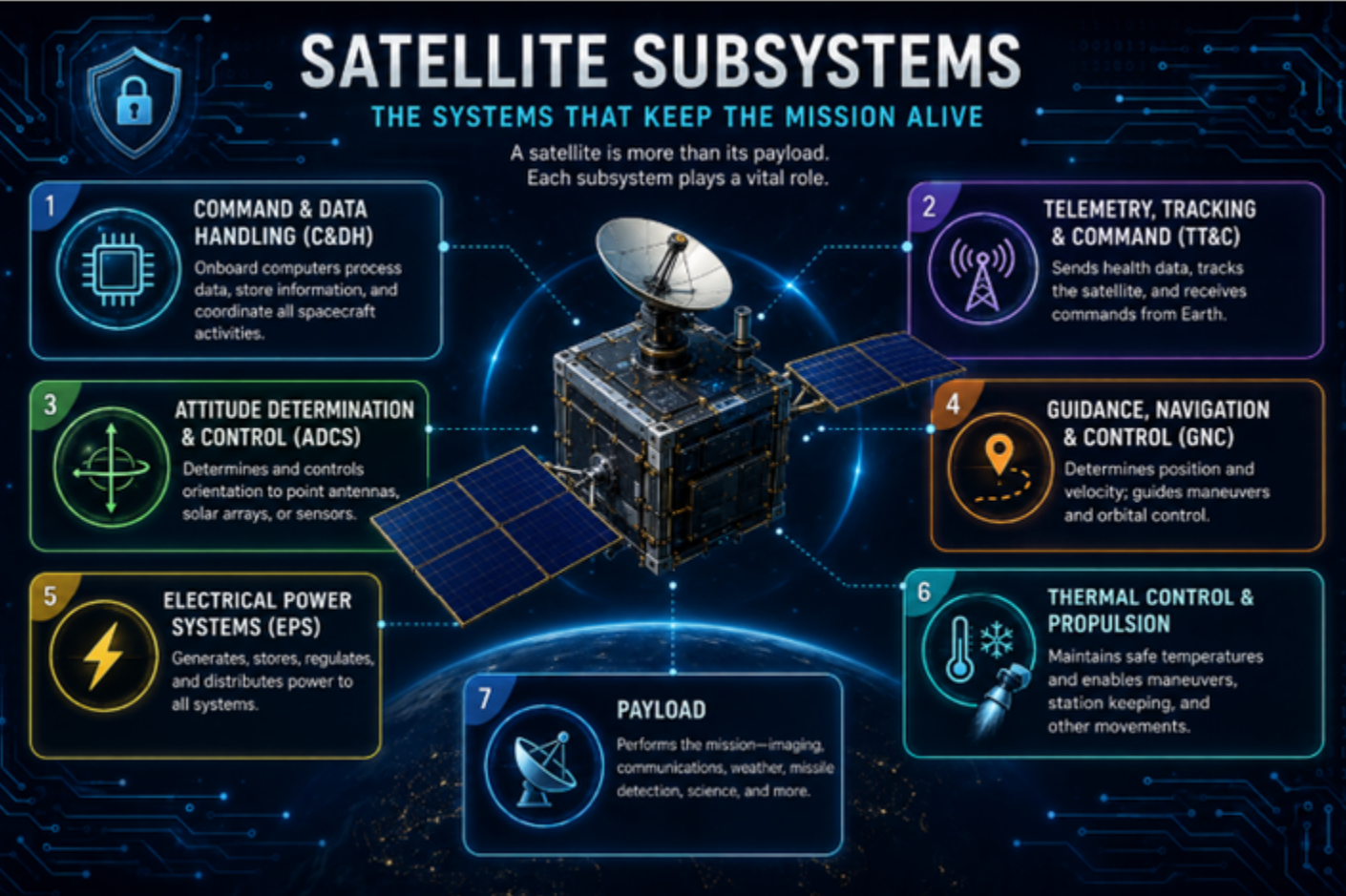
A satellite may appear to be a single system, but is part of a much larger interconnected network. Understanding how a satellite functions within that network begins with looking at the systems operating inside the spacecraft itself. Satellite systems are complex, consisting of numerous interconnected subsystems working together. For example, NASA identifies several spacecraft capabilities, to include communications, flight computing and avionics, guidance, navigation and control, power, propulsion, software and autonomous systems, and thermal management. However, the exact configuration of satellite subsystems varies according to the spacecraft and its mission, but several subsystems are common:

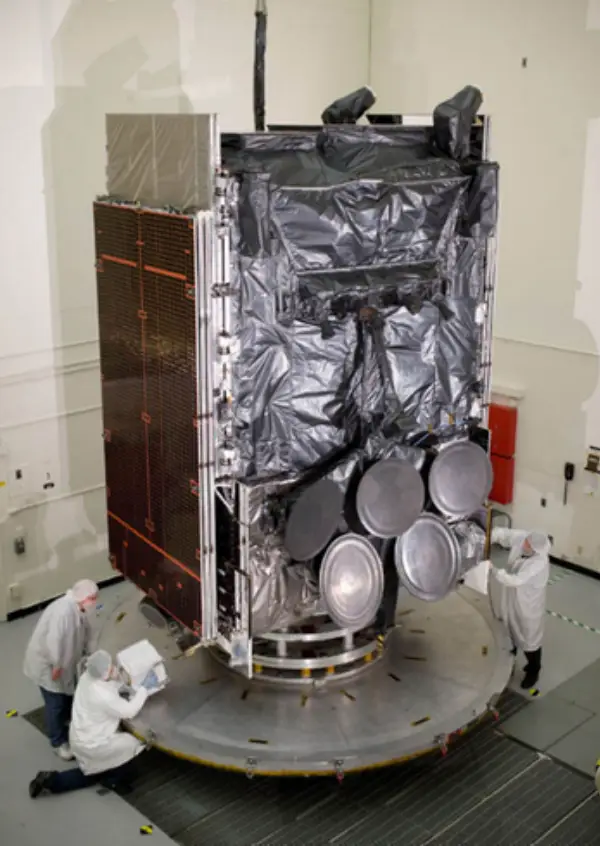
WGS at El Segundo, CA – AmericaSpace

Command and Data Handling (C&DH) functions as part of the satellite’s central nervous system. Onboard computers and processors receive commands, process information, store data, and coordinate activities among other spacecraft systems.

Telemetry, Tracking, and Command (TT&C) provides a critical connection between the spacecraft and operators on Earth. Telemetry tells operators about the satellite’s condition, tracking helps determine its position, and command capabilities allow operators to direct spacecraft activities.

Attitude Determination and Control (ADCS) determines and controls the spacecraft’s orientation. This allows a satellite to point an antenna toward Earth, orient solar arrays toward the Sun, or direct an imaging sensor toward a specific location.

Guidance, Navigation, and Control (GNC) helps determine where a spacecraft is and how it should move or maneuver. NASA describes GNC as integral to vehicle flight performance and mission requirements.

Electrical Power Systems (EPS) generate, store, regulate, and distribute the electrical power needed to operate the spacecraft. Without sufficient power, even a completely functional payload cannot perform its mission.

Thermal control systems keep spacecraft components within acceptable temperature ranges, while propulsion systems enable orbital maneuvers, station keeping, and other spacecraft movements.

Finally, the payload performs the satellite’s primary mission. Depending on the spacecraft, that could mean taking images, collecting weather information, providing communications, detecting missile launches, or performing scientific observations.

Connecting these functions are onboard computers, processors, memory, firmware, software, and internal data interfaces. NASA specifically describes modern spacecraft avionics in terms of commanding and data-handling architectures and identifies mission-critical embedded software, software integration, and hardware-in-the-loop systems as important parts of spacecraft development. This interconnectedness is where cyber becomes important.

The Cyber Attack Surface

According to NIST, the increasing dependence of space systems on digital technologies has expanded the number of potential pathways through which cyber vulnerabilities may be introduced or exploited. A satellite does not operate independently; it functions as part of a broader architecture in which spacecraft, ground infrastructure, communications links, software, and users continuously exchange commands and data. Collectively, these interconnected components and interfaces constitute a cyber attack surface—the points within a system through which an adversary may attempt to gain unauthorized access, manipulate information, disrupt operations, or otherwise affect system functionality.

Within the space segment, cyber risk is closely tied to the satellite’s dependence on onboard computing and communications. Modern spacecraft rely on processors, memory, flight software, firmware, and internal data buses to coordinate activities among subsystems. External communications links enable operators to transmit commands to the spacecraft and receive telemetry and mission data in return. Software and configuration updates may also provide mechanisms for modifying spacecraft functionality after launch. While these capabilities are essential to satellite operations, each interface represents a potential point of exposure that must be protected against unauthorized access or manipulation.

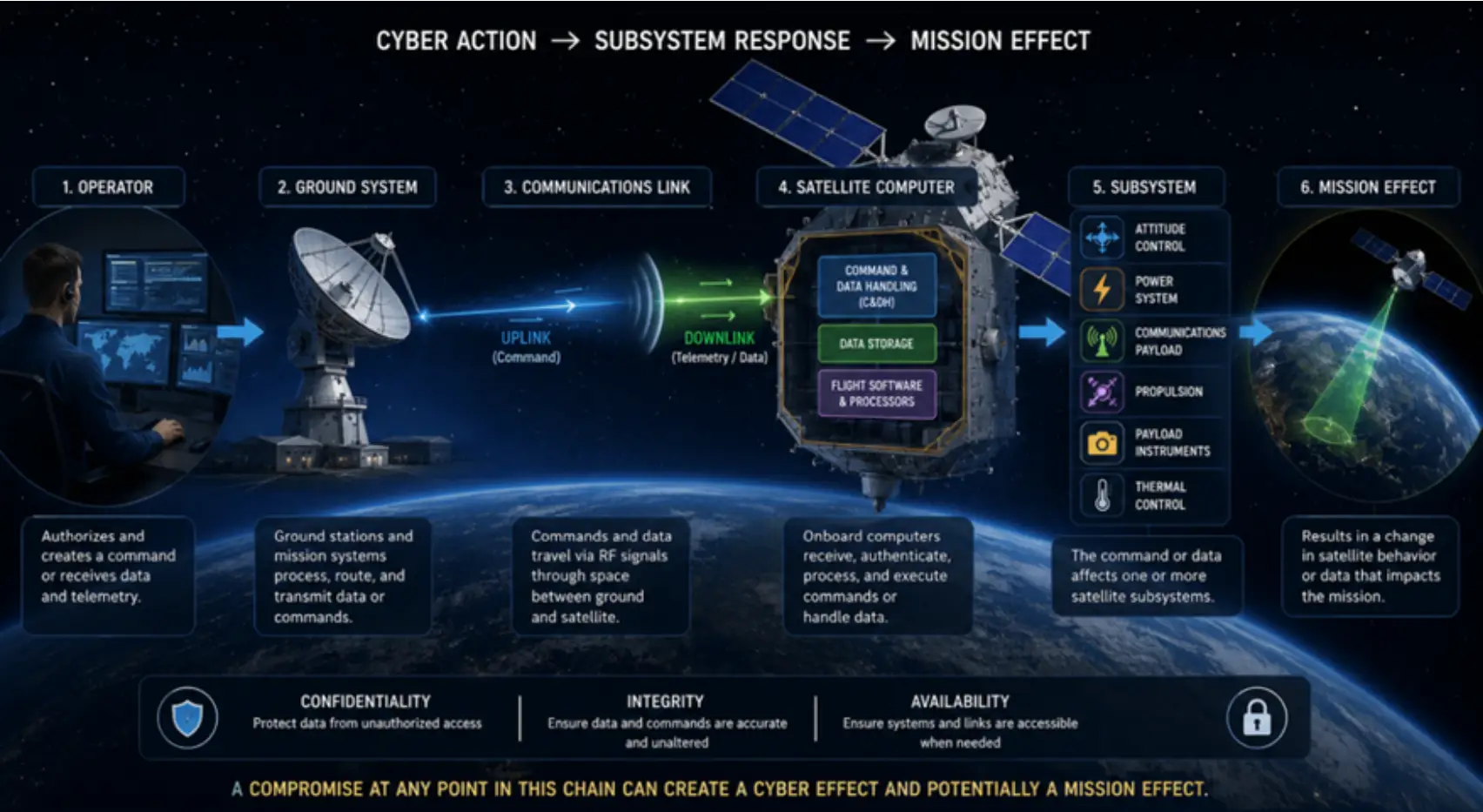
The relationship between these components is particularly important when considering cyber risk. A command generated by an authorized operator may pass through terrestrial networks and a ground station before being transmitted across a radio-frequency link to the spacecraft. Once received, onboard systems authenticate and process the command before directing the appropriate subsystem to perform an action. Telemetry and mission data travel through a similar chain in the opposite direction. Cybersecurity must therefore protect not only individual components but also the integrity and authenticity of the information exchanged between them.

This interconnected architecture means that a vulnerability in one component may have consequences elsewhere in the system. Compromise of a communications interface, onboard software, command-processing function, or data pathway could potentially influence the operation of another spacecraft subsystem. The cyber risk to a satellite is therefore best understood not as a single vulnerability or access point, but as a function of the interdependencies among hardware, software, communications, and spacecraft control functions.

Conceptually, the process looks like this:

Cybersecurity helps ensure that the person issuing the command is authorized, the command has not been altered, the satellite recognizes it as legitimate, and the receiving subsystem performs the intended action. If any portion of that chain is compromised, the consequences can extend beyond the compromised computer or network.

From Cyber Effect to Space Effect

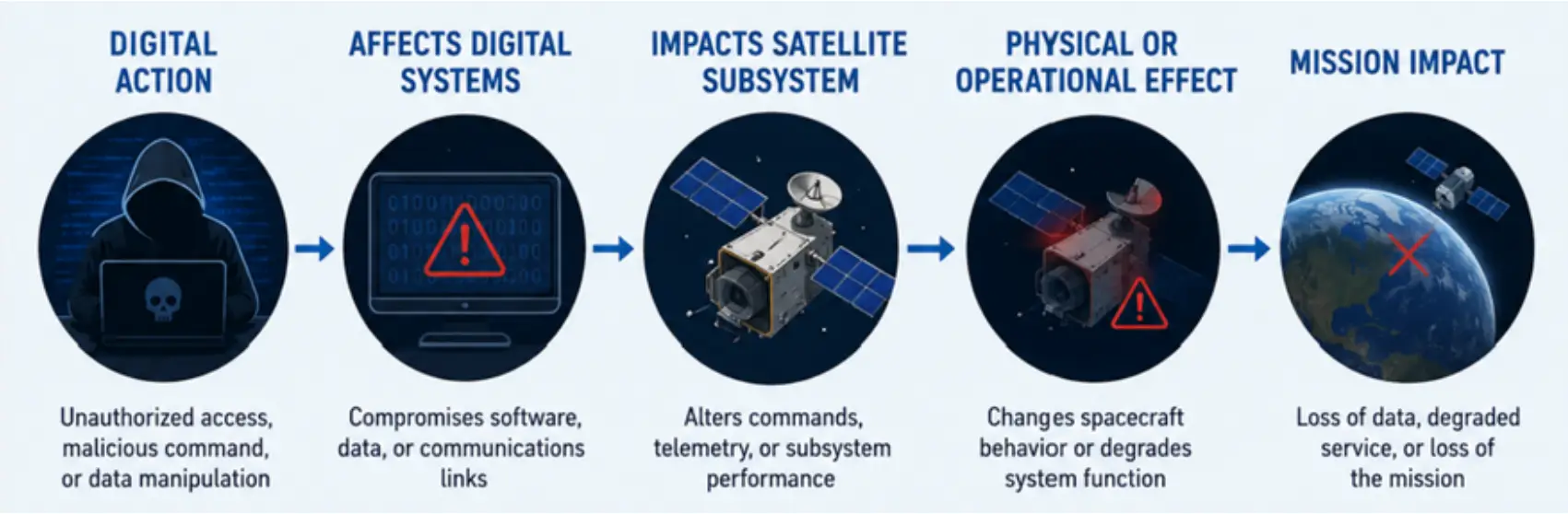
This is what makes cybersecurity particularly important to space operations. For example, unauthorized access to mission data could compromise its confidentiality. Manipulated telemetry could provide operators with inaccurate information about spacecraft health. Interference with command functions could prevent operators from controlling a satellite

Compromised software could affect how an onboard computer processes commands or communicates with other spacecraft subsystems. In 2023, the European Space Agency demonstrated this risk using its OPS-SAT nanosatellite. During a controlled cybersecurity exercise, researchers exploited a vulnerability in software uploaded to the spacecraft and gained access to its control layer. The researchers were then able to manipulate imagery and change the satellite’s attitude, causing the spacecraft to rotate away from its intended orientation. Although the exercise was controlled and the satellite was safely restored, it demonstrated how compromising software can move beyond a digital effect and influence the physical operation of a spacecraft.

Space Force Doctrine Note explains in more serious circumstances, manipulation of spacecraft functions could potentially affect payload operations, communications, power management, spacecraft orientation, or other mission-critical functions.

The U.S. Space Force’s Space Systems Command has characterized satellite hacking as a real and growing space threat, emphasizing that cyber risk is not limited to traditional terrestrial computers. NIST similarly notes that as space capabilities become increasingly important to critical infrastructure, the potential consequences and corresponding risks associated with cyberattacks increase.

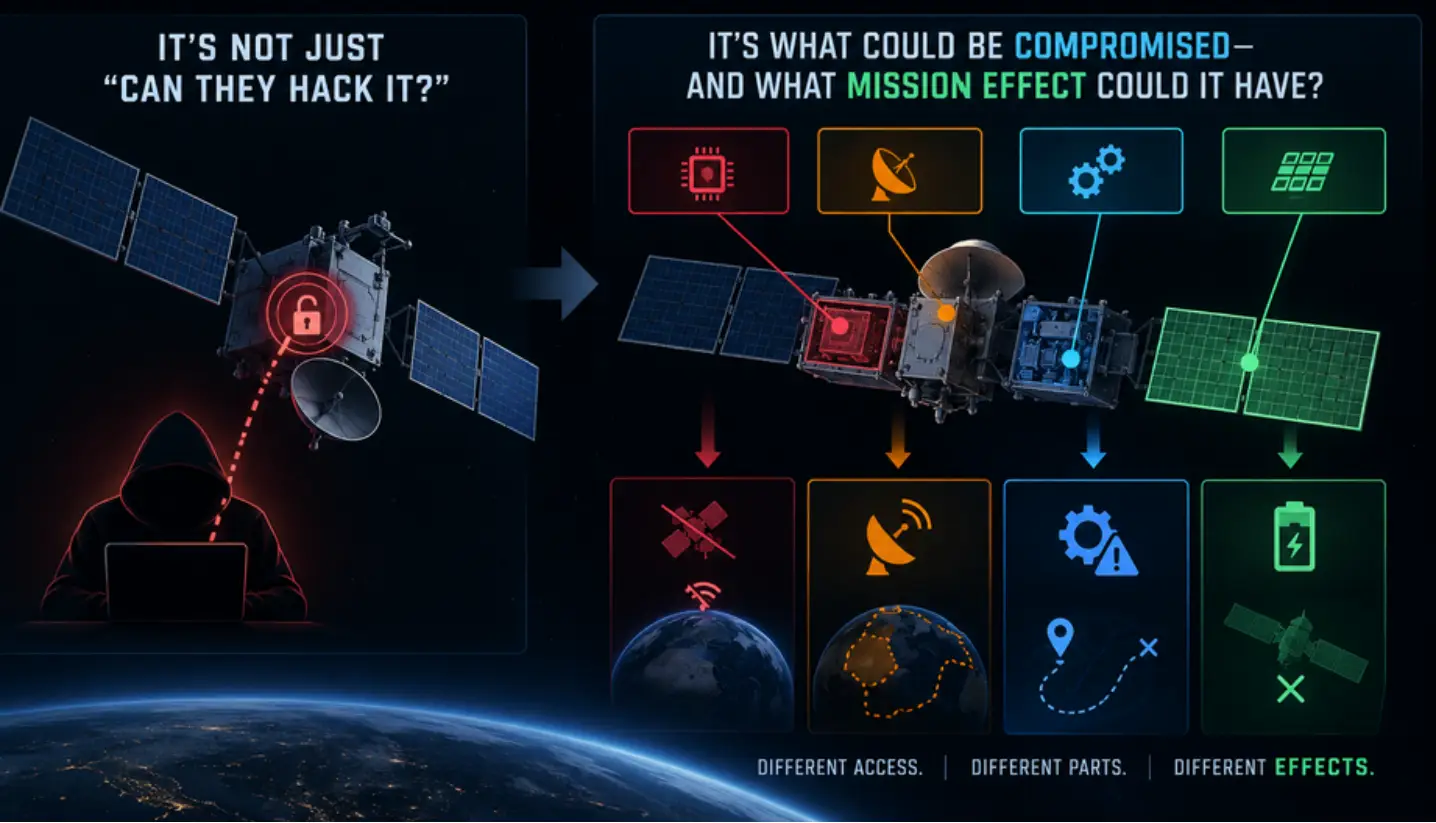
When people think about a cyberattack against a satellite, the most dramatic scenario often comes to mind: an adversary gains control of the spacecraft and begins issuing unauthorized commands. However, compromising a space system does not necessarily require taking control of the satellite itself.

An early example occurred in 1999, when 15- year-old hacker Jonathan James gained unauthorized access to NASA computer systems and downloaded proprietary software associated with supporting the International Space Station’s physical environment, including temperature and humidity control. NASA subsequently took affected systems offline for approximately three weeks while it investigated and restored operations.

James did not hijack a spacecraft, but the incident illustrates a much broader cybersecurity problem: an attacker does not need complete control of a satellite to affect the systems that support a space mission.

Jonathan James – Instagram

Cyber operations can target the computers, software, networks, communications links, ground infrastructure, and data upon which spacecraft operations depend. Focusing only on the possibility of someone “hijacking” a satellite can therefore obscure the larger issue—the space system as a whole presents a cyberattack surface.

An attacker may not need control of the satellite to affect the mission. Compromised data could undermine the information operators and decision-makers rely on. Disrupted communications may prevent information from reaching users. Interference with command links could limit an operator’s ability to control the spacecraft. Even the compromise of a single subsystem could degrade performance or prevent the satellite from accomplishing part of its mission.

In other words, the significance of a cyberattack is not determined solely by how much of the satellite an attacker controls, but by what operational effect the compromise produces. The more useful question, therefore, is not simply: “Can an adversary hack a satellite?” It is: “What part of the space system could an adversary compromise—and what mission effect could that compromise produce?”

The Satellite Is Only One Part of the Problem

Understanding the satellite’s internal architecture is the first step toward understanding the larger cyber threat to space operations. But the spacecraft represents only one part of the overall attack surface.

The satellite communicates with antennas and ground stations. Ground stations connect to networks and mission systems. Operators use computers and software to create and transmit commands. Satellite data may travel through different segments before reaching the people who depend on it. This is why NIST’s work on space cybersecurity extends beyond spacecraft and includes specific guidance for the satellite ground segment, including the systems responsible for command and control of satellite buses and payloads.

The challenge is becoming more important as the number and diversity of satellites increase. Commercial organizations now operate alongside governments, militaries, universities, and other organizations in space. At the same time, reduced barriers to space access have contributed to thousands of satellites operating in orbit and a much wider variety of actors participating in space activities. The result is a space environment that is increasingly interconnected—and increasingly dependent on cybersecurity.

Cyber Risk Doesn’t Stop at the Atmosphere

The central point of this first article is simple: satellites are cyber-physical systems. Computers and software control physical spacecraft. Communications networks connect operators on Earth to systems in orbit. Data moves continuously between spacecraft, ground infrastructure, and users. A cyberattack against one component can therefore create effects elsewhere in the architecture.

A cyberattack does not need to seize complete control of a satellite to affect its mission. Compromising the confidentiality of sensitive information, manipulating the integrity of data, denying communications, or disrupting a critical subsystem may be enough to degrade—or even deny—the capability the satellite was designed to provide. Understanding these dependencies is therefore fundamental to understanding cyber threats to space. But the cyber story does not begin in orbit.

Long before a satellite reaches the launch pad, it has already passed through an extensive network of manufacturers, suppliers, software developers, and technology providers. Its processors, memory, firmware, communications equipment, sensors, and thousands of other components may originate from different companies and locations around the world.

As the commercial space industry expands and spacecraft increasingly incorporate commercially available technologies, that network becomes larger—and potentially more difficult to secure. So perhaps the next question is not simply, “How do we protect a satellite from a cyberattack?” But rather, “What if the vulnerability was already there before the satellite ever left Earth?”

Next in the series, we’ll follow the cyber risk back to where the satellite begins—on Earth. As commercial technology and COTS components become increasingly common in spacecraft, processors, software, firmware, and hardware may pass through complex global supply chains long before reaching the launch pad. The next cyber vulnerability may not begin in orbit—it may already be built in.