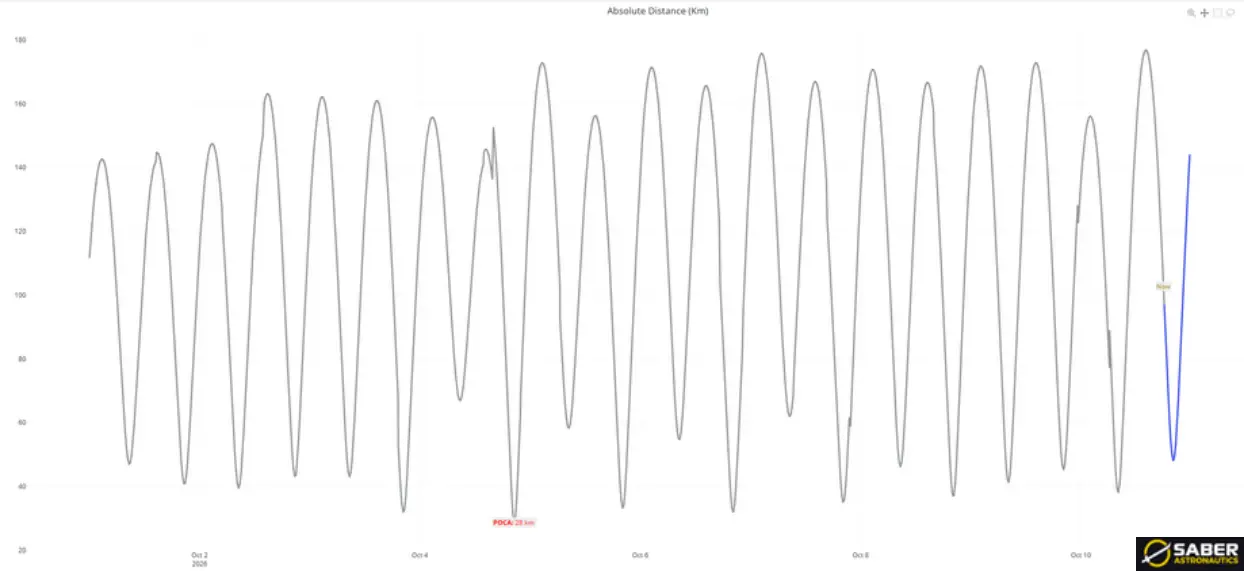
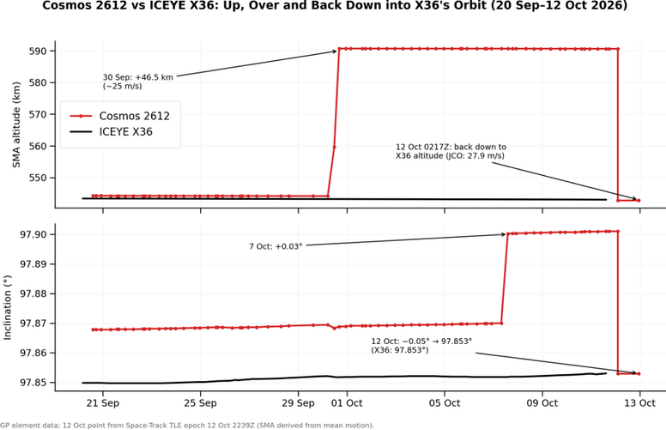
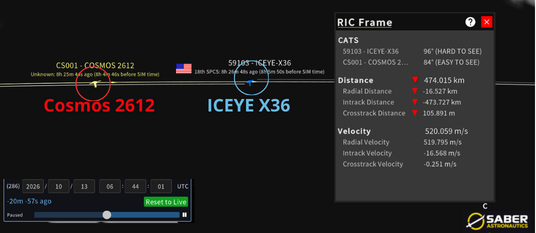
12 Oct 2026: Commercial SDA providers supporting the JCO detected a possible RPO initiation by Cosmos 2612 (68762) against ICEYE X36 (59103). At 0217Z, Cosmos 2612 executed a 27.9 m/sec burn that dropped its orbital period 59.5 seconds (perigee −43.8 km, apogee −51.9 km) and lowered its inclination ~0.05° to 97.85°. The burn put 2612 back near X36’s altitude (555 vs 556km respectively), into X36’s inclination, and into X36’s orbital plane in a single maneuver. The satellites are currently (as of 12-13 Oct) ~475km apart with Cosmos 2612 trailing X36 and slowly catching up. Without further maneuver the two satellites will be ~90km apart, but the separation will be almost entirely in-track. The evidence points to Russia setting up a rendezvous with a commercial SAR satellite that supports Ukraine. For what purpose is unknown.
Recap: In Issue 146 (1 Jun) we reported that Cosmos 2610–2614 executed ~0.8° plane changes in mid-May that left all five nearly co-planar with ICEYE X36. In Issue 152 (23 Aug) we noted the five were stacked 0.6–5.2 km above X36, slowly phasing through the plane, and none had maneuvered to stay plane-matched. Cosmos 2612 was the closest, just +0.6 km above X36.
The Setup: Up, Over and Back Down
In hindsight, the last two weeks look like one deliberate sequence:
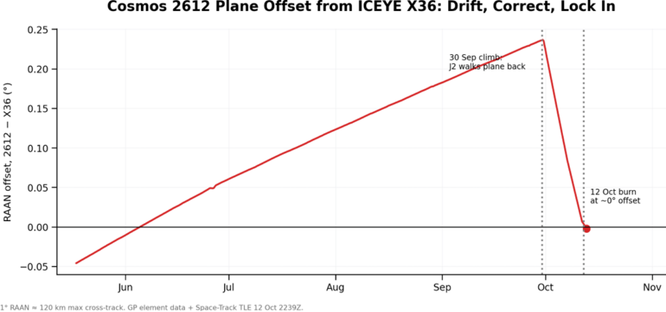
- Problem (May–Sep 2026): Sitting slightly above X36, 2612’s plane precessed a little slower than X36’s. By 30 Sep its RAAN had drifted ~0.24° from X36’s (~28 km of maximum cross-track separation). Fixing that directly would take a ~31 m/sec cross-track burn.
- 30 Sep 2026 climb (~25 m/sec): Raising 2612 ~46.5 km to ~590 km slowed its precession enough that J2 walked its plane back toward X36’s at ~0.02°/day. At the same time, the higher orbit had 2612 drifting ~55°/day relative to X36, a fast way to adjust its in-track phase.
- 7 Oct 2026 trim (~4 m/sec): A small inclination increase (97.870° → 97.901°) fine-tuned the precession rate. In hindsight it most likely timed the plane crossing to the planned descent window.
- 12 Oct 2026 descent (27.9 m/sec): With the planes aligned, 2612 dropped back to X36’s altitude and trimmed its inclination to match, locking in the alignment. Because both satellites now sit at nearly the same altitude, they precess at the same rate and the planes will stay matched without further cross-track burns.
The two-week round trip cost ~57 m/sec. Russia got two things for it: a corrected plane and a new in-track position relative to X36. A direct plane fix would have cost about half as much but done nothing for phasing. I had initially believed the initial climb was to reform the co-planar relationship with Cosmos 2610, 2611, 2613 and 2614. The 12 October maneuver makes it clear that proximity to X36 is the objective.
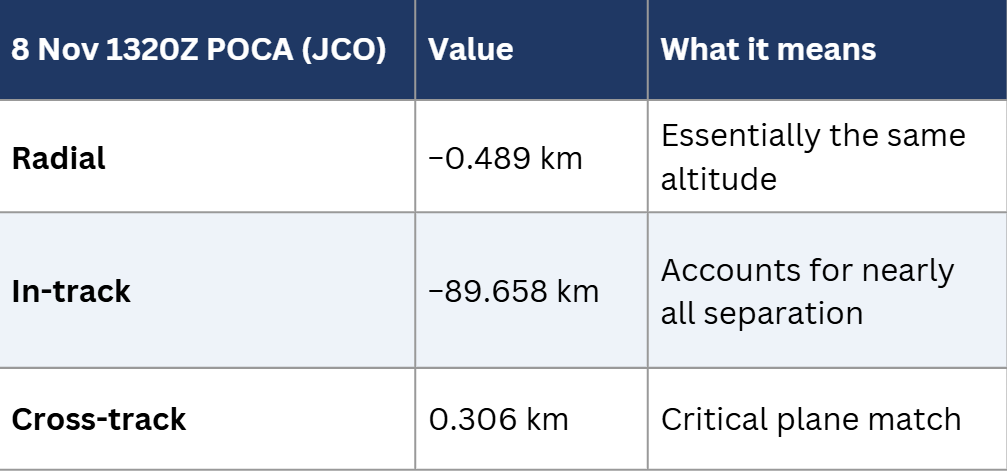
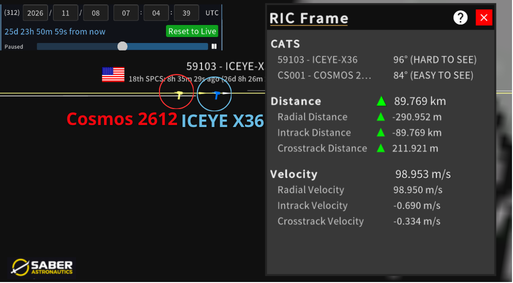
Now What: Cosmos 2612 trails ICEYE X36 by ~475km. That it is now virtually co-planar is the primary concern. After matching X36’s orbital plane, closing the in-track gap can be done quickly and requires little fuel. As things stand now, Cosmos 2612 is ~1km lower than ICEYE X36 and slowly catching up. Assuming no additional maneuvers the two satellites will be <90km apart on 8 Nov 2026. (see table)
Why This Is Different
- Plane and (nearly) shape matched: the first step in setting up an RPO is plane matching (matching inclination and RAAN). The second step is shape matching…eccentricity and argument of perigee. Both 2612 and X36 have eccentricities of .002 and their Argument of Perigee is separated by 4° (estimated 0.25m/sec of delta-v).
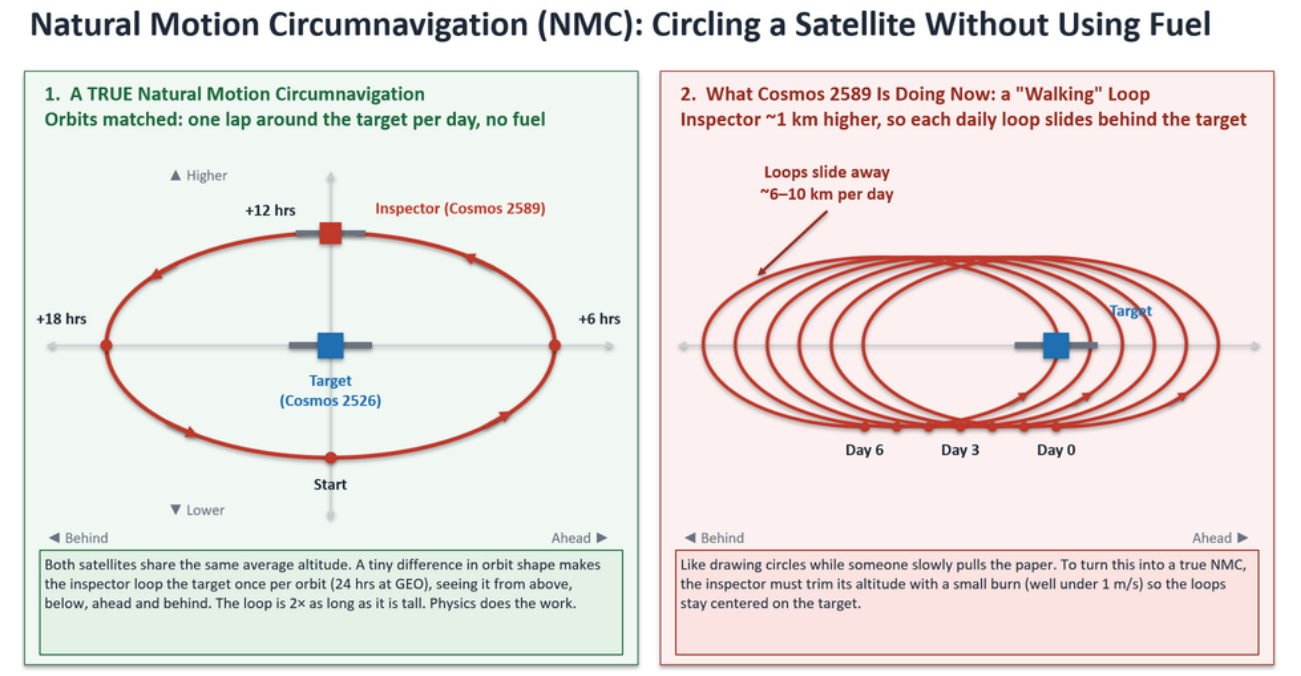
- The expensive part is done: With the plane matched and the shape nearly so, the remaining ~90 km takes only small in-track phasing burns to match the satellites’ True Anomaly values. Such an in-track maneuver could happen easily and Russia would determine the closure rate. As things are today, 2612 can hold any standoff range it chooses, including natural-motion circumnavigation once it gets close.
- X36 can’t do much about it: X36 is a ~90 kg smallsat. Its last detectable maneuver was a ~0.6 km SMA reduction on 25–27 June. Unknown if it has available propellant or agility to evade.
- Intent signaled: In October 2022 Russian MFA official Konstantin Vorontsov warned at the UN that commercial satellites supporting Western militaries could be “legitimate” targets. ICEYE imagery supports Ukrainian targeting. 2612 now has the geometry to act on that warning.
We still do not know what Cosmos 2612 carries or its capabilities. We do know that it is now in an orbit where Russia could execute collection, non-kinetic or kinetic operations.
Fuel Accounting
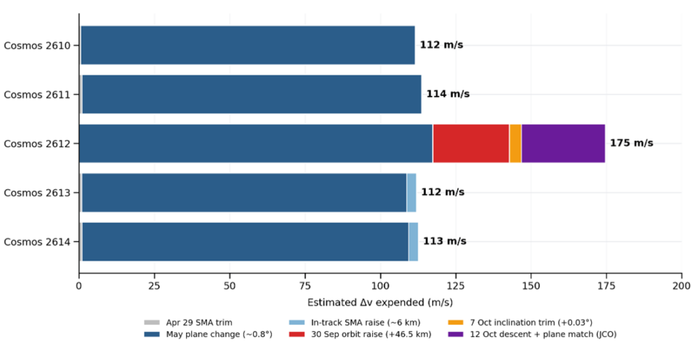
With the 27.9 m/sec added, Cosmos 2612 has now expended ~175 m/sec since launch, ~60 m/sec more than any of its four siblings. Russia was willing to spend ~57 m/sec in two weeks to set up this approach and still has propellant for the terminal phase. The other four, at ~112–114 m/sec each, have not maneuvered since July.
What to Watch For
- Decrease in SMA to close the in-track gap: Cosmos 2612 currently trails ICEYE X36 so a decrease in SMA will result in 2612 catching up with the targeted satellite.
- ICEYE response: any avoidance maneuver by X36, or public statements from ICEYE or the governments it supports.
- The other four: 2612 has now shown the full template: climb, let J2 do the plane work, descend into the target’s orbit. Watch Cosmos 2611 and 2613, whose planes are converging on ICEYE X37’s (crossings ~6 and ~15 Nov), for a similar sequence.
Editor’s Comments: My initial thoughts were that the 30 Sep climb represented 2612 walking away from X36. It was the opposite. Russia used altitude and J2 to fix a 0.24° plane drift, used the same climb to re-phase, and then dropped 2612 into X36’s orbit at the moment the planes lined up. That is a patient, efficient and well-executed rendezvous setup, and it removes any remaining doubt for me that Cosmos 2612 is interested in ICEYE X36. A Russian military satellite is now plane and shape-matched with a commercial radar satellite that supports Ukraine, and all that is left is in-track distance Russia can close cheaply and on its own schedule. More updates to follow.