
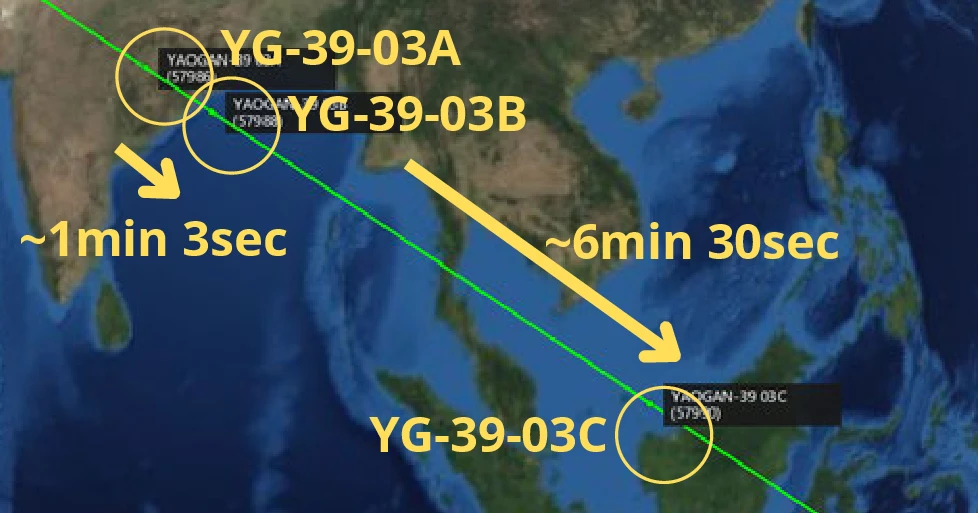
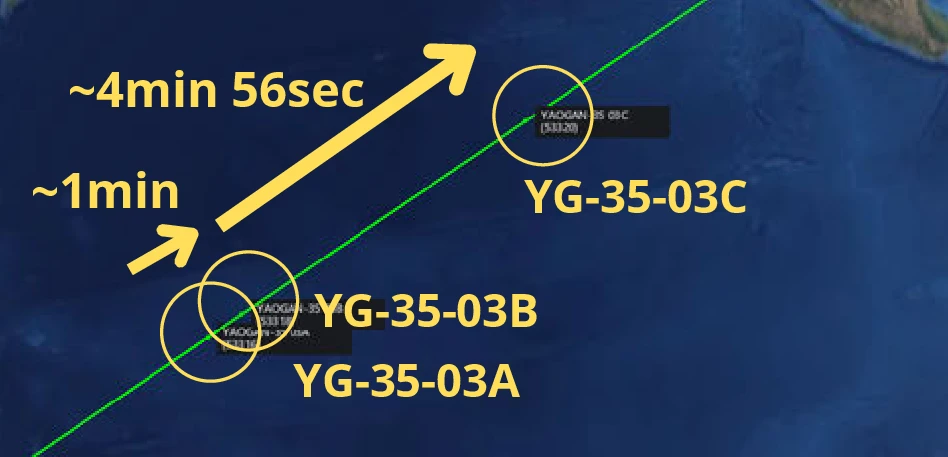
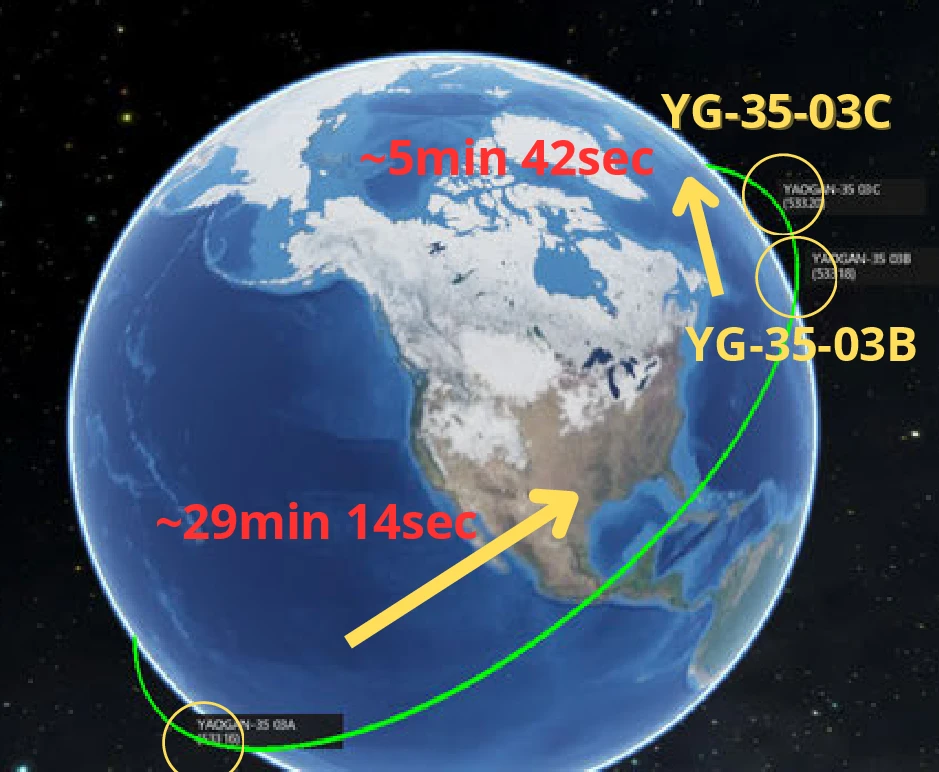
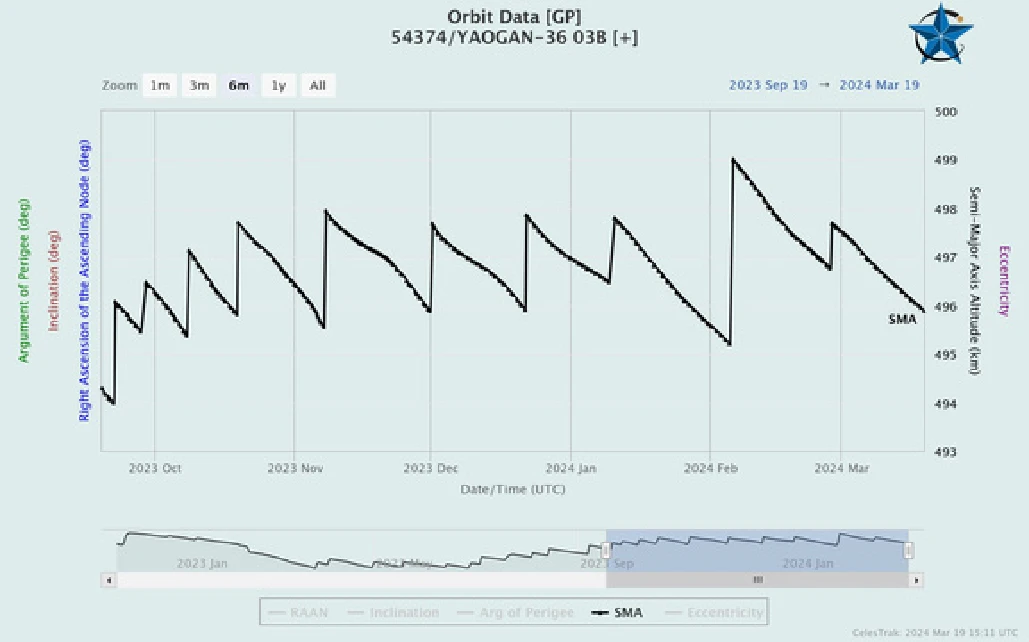
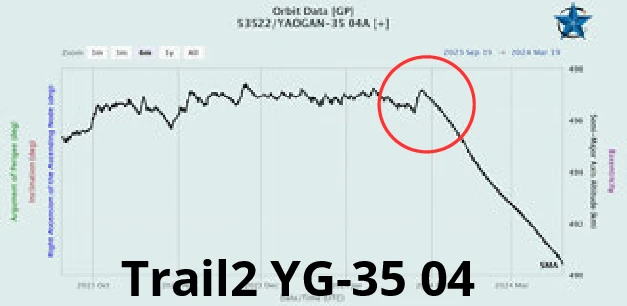
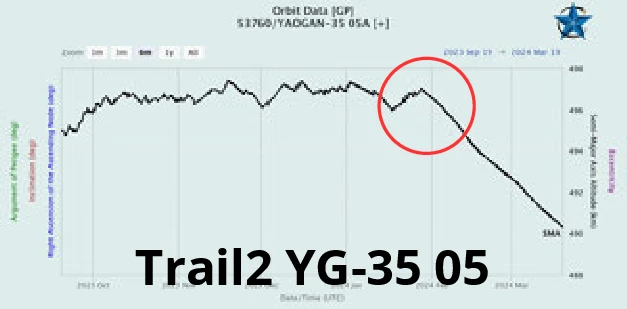
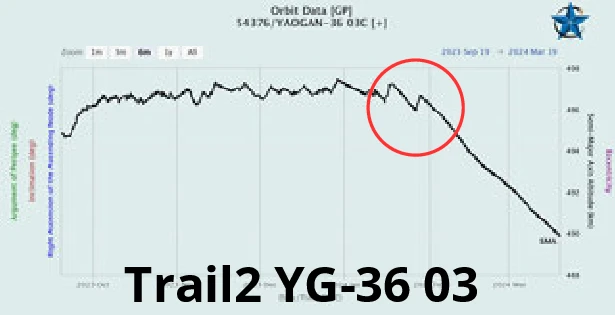
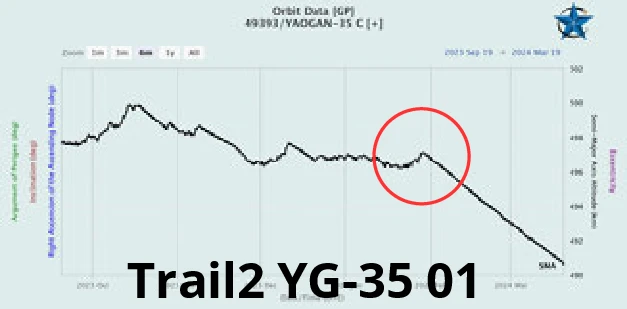
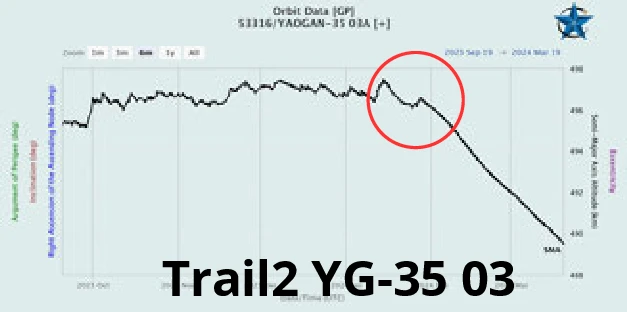
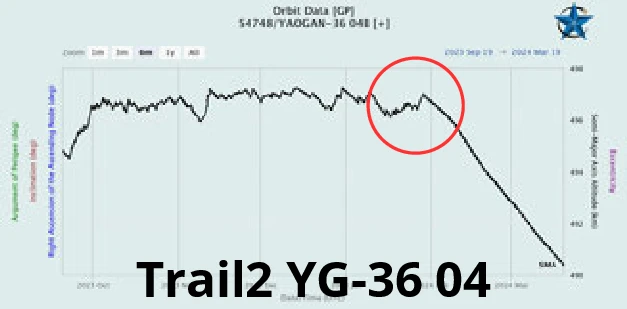
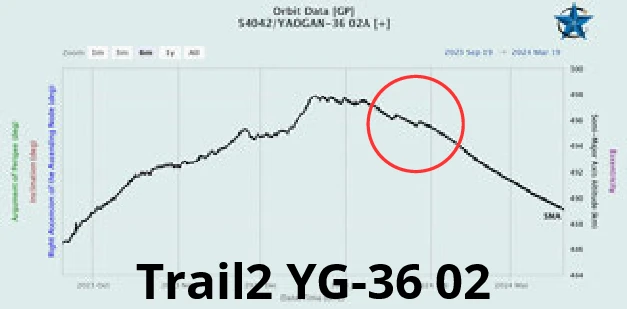
Seven YG-35/36 Trail2 satellites decreased their altitudes, changing the timing and geometry of multiple lead-trail formations.
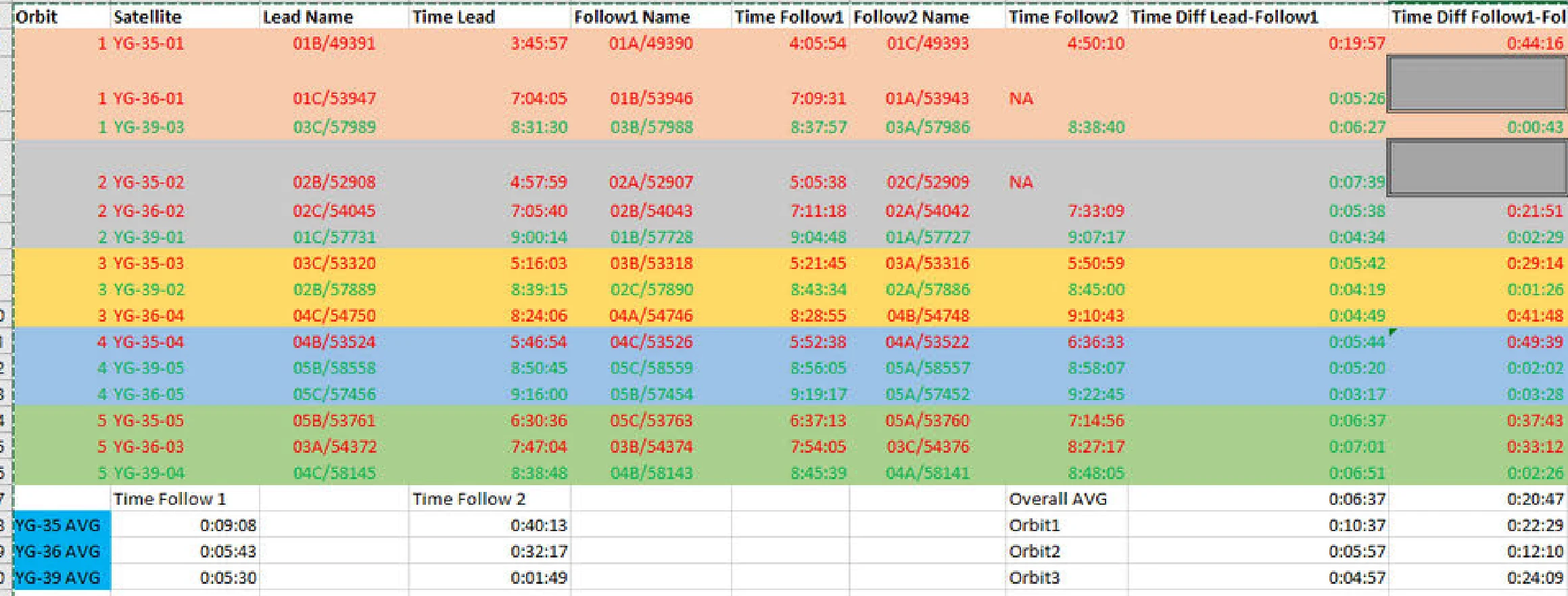
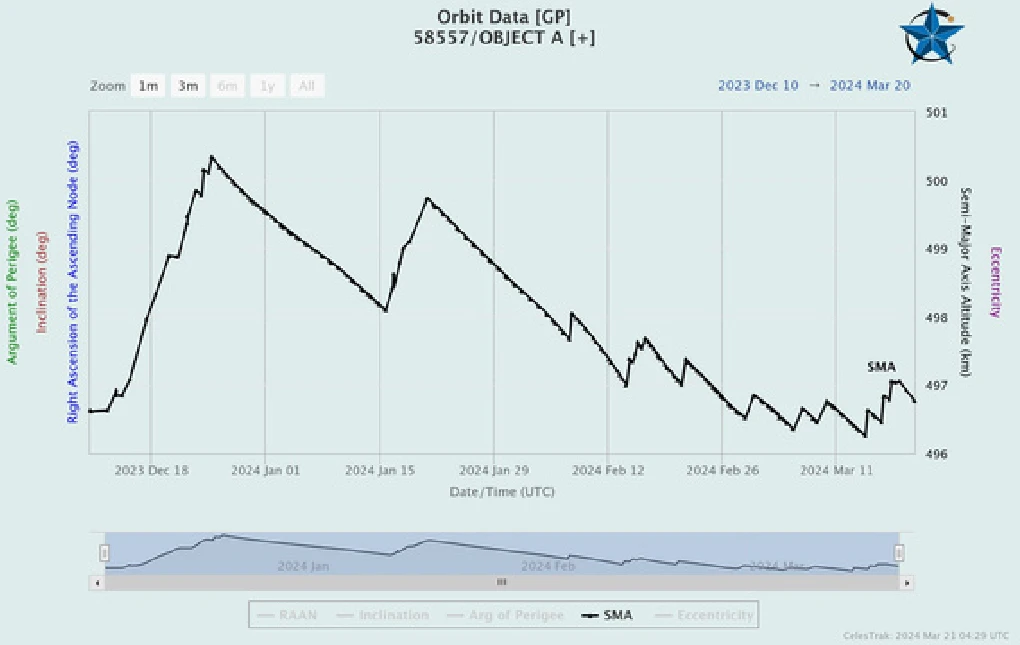
20 Mar: Checking in on the YG-35/36/39 satellites it appears that a significant number have (at least temporarily) fallen out of the “lead-trail1-trail2” formation. On ~29 Jan 2024 seven of the Trail2 satellites began decreasing their altitudes, thus increasing their orbital velocity (thanks again for the 10:1 explanation Jack!) As a result the Trail2 satellites for seven of the triplets passed both Trail1 and Lead satellites in early-Feb. In Dec 2023 the average time between YG-35 Trail1 & Trail2 was 1min 02sec. On Mar 20 the time difference was 40min 13sec. The average time difference for the 5 YG-36 triplets has increased from ~2min 47sec in December 2023 to ~32min 17sec in Mar 2024. The Lead to Trail1 time differential has remained relatively unchanged. The newest satellites, the YG-39s all appear to be holding their original formation.
6 of the 15 triplets (40%) appear to be in “standard” formation. There appears to be some correlation with launch dates as only the more recently launched YG-39 triplets (01-05) appear to be maintaining their relative positions with one another. YG-39-01-05 are all in what was the standard formation with the average Lead-Trail1 being ~5min 30sec and Trail1-Trail2 at ~1min 49sec. I’m counting YG-36-05 as still being “good” but it’s formation stretching out, Lead-Trail1 ~3min 17sec and Trail1-Trail2 ~3min 28sec.
Trail2 satellites for all of the YG-35 triplets and 4 of 5 YG-36 triplets decreased their altitudes on ~29 Jan 2024. YG-35 Trail1-Trail2 time is now over 40min. For YG-36 01-04 triplets Trail1-Trail2 time difference increased from 2min 47sec in Dec 2023 to 32min 17sec in Mar 2024. The average Lead-Trail1 has remained steady ~6min 02sec in Dec 2023 and ~5min 43sec in Mar 2024. These averages do not include the 2 wayward satellites described below.
Two of the 45 satellites continue their slow orbital decay and have shown no signs of maneuverability for over a year. YG-35-02C last maneuvered in Nov 2022 and its SMA is now 351.2km and dropping. YG-36-01B last maneuvered in Jan 2023 and now has an SMA of 407.6km and also continues to decline.
China likely executed a planned formation adjustment for 7 of the 15 triplets on 29 Jan 2024. It will be interesting to see if the 7 Trail2 satellites increase their altitudes and re-form with Lead and Trail2 satellites in the coming weeks.
SMA declines began ~29 Jan 2024 for seven Trail2 satellites (celestrak.org).
China’s WHG-01 satellite circularized in GEO at 33.7°E, over Africa and due south of Eastern Ukraine.
15 Mar: After spending 2 weeks in Geostationary Transfer Orbit (GTO) China’s Weixing Hulianwan Gaogui-01 (WHG-01) circularized its orbit in GEO on ~13 March. The satellite is now over Africa (and due south of Eastern Ukraine) at 33.7°E longitude. There was conjecture that China might intend to use the satellite to provide connectivity in the extreme Northern and Southern latitudes, however the satellite is 0° inclined making this impossible. There is also the potential that “high” in this case refers to throughput, or perhaps it has another mission entirely, one which would benefit from being over an active combat zone. China has not released any additional information regarding the WHG-01’s mission.
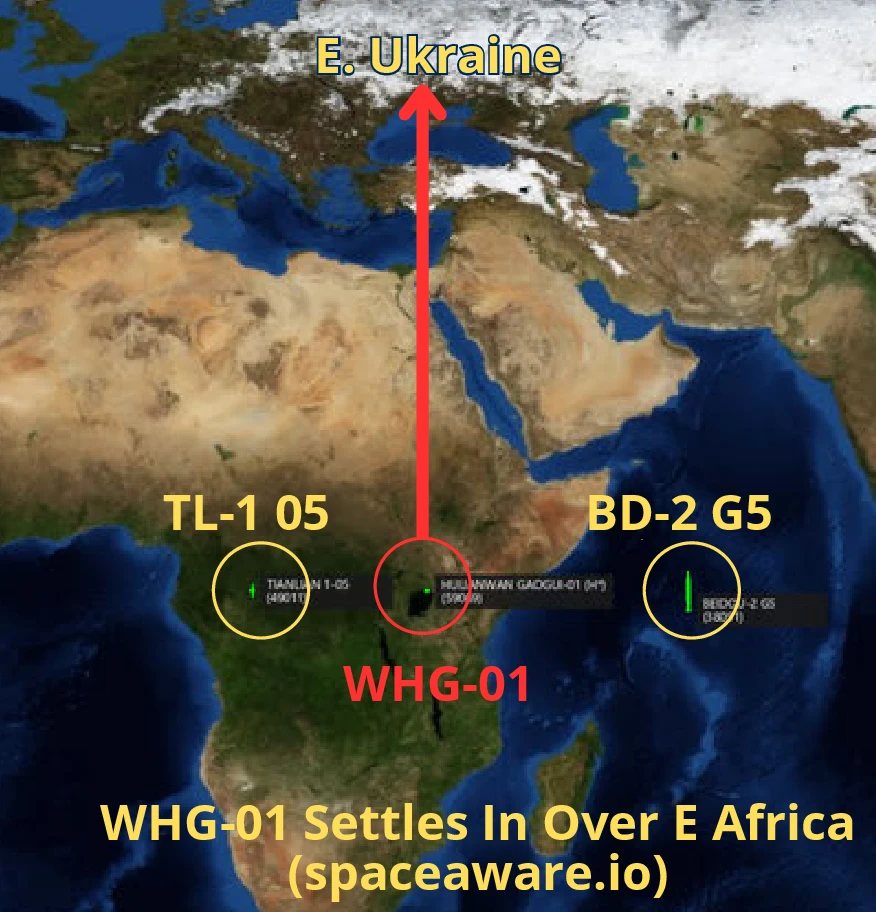
This location would be well-suited to support or observe ongoing operations in the Ukrainian-Russian conflict.
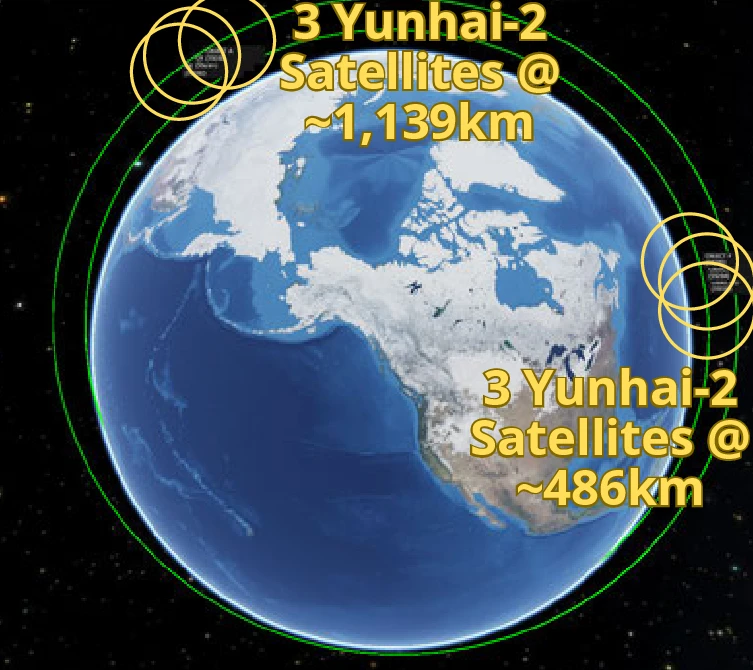
China launched six Yunhai-2 Group 02 satellites into two distinct orbital altitudes from Jiuquan.
21 Mar: China launched a LM-2D from Jiuquan carrying the second group of Yunhai-2 satellites. The Yunhai-2 satellites are “mainly used in the fields of detection of atmospheric environmental elements, space environment monitoring, disaster prevention and mitigation, and scientific experiments”. Yunhai-2 Group 1 launched in 2018. As with the 6 Group 1 satellites, Group 2 deployed in 2 distinct orbits, 3 satellites to 486km and the other 3 to 1,139km. Inclination is identical. The Group 1 satellites eventually equalized their altitudes at ~800km.
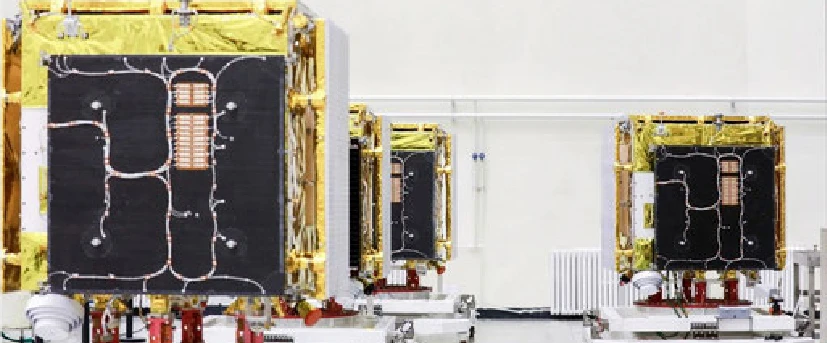
China’s four PIESAT SAR satellites appear to be experimenting with changing relative positions in formation.
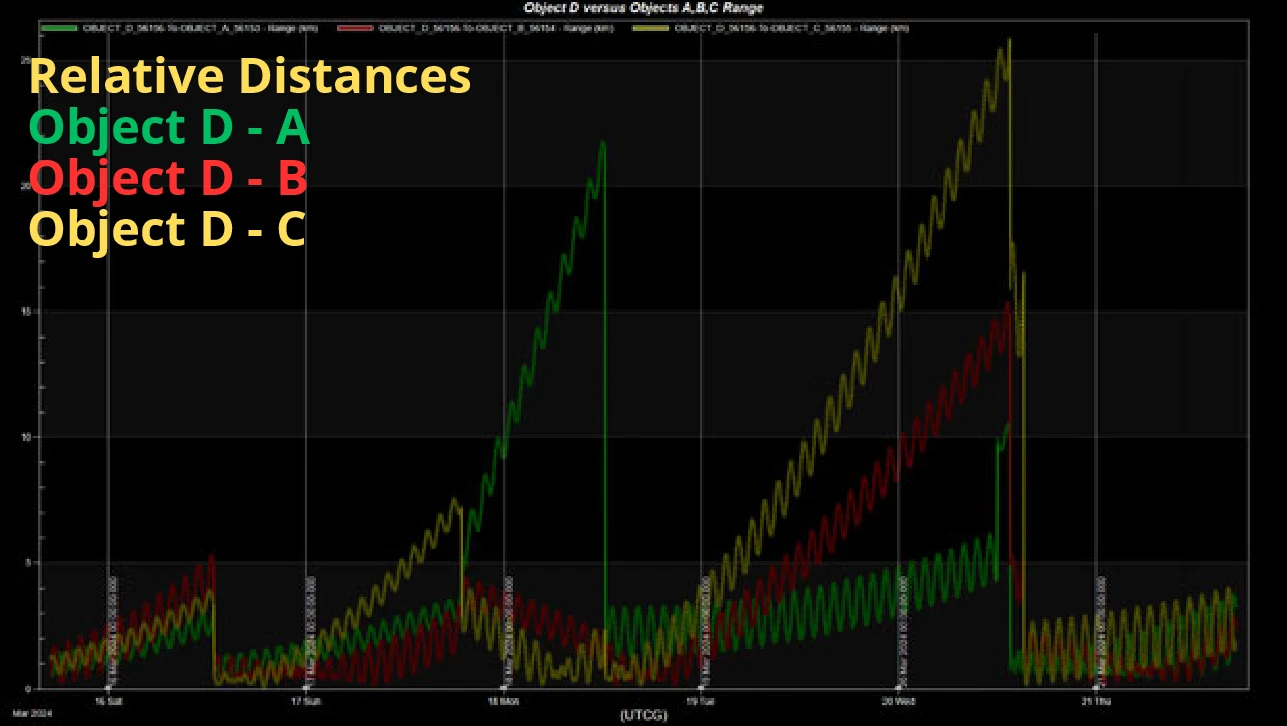
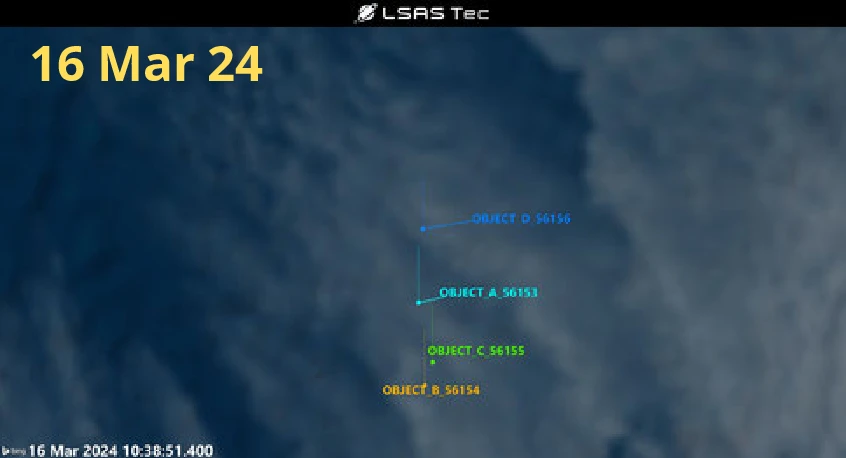
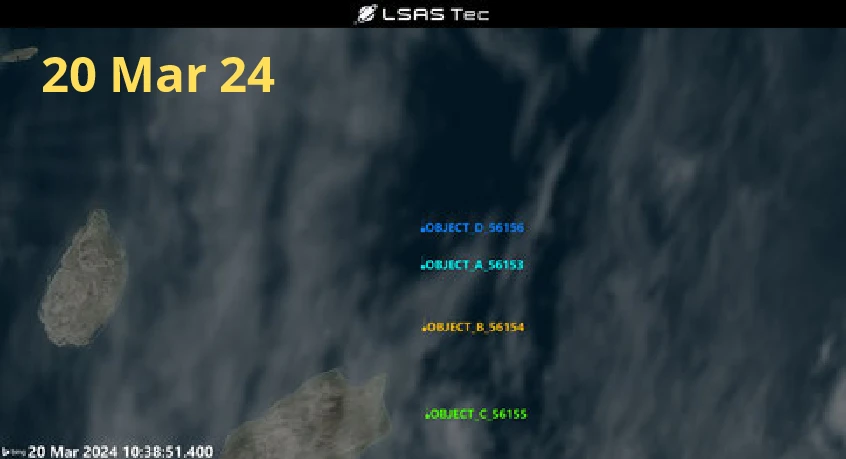
15 Mar: After spending nearly a year on orbit it appears as if China’s 4 PIESAT SAR (2023-047) satellites are beginning to operate in formation. China launched the four satellites 30 Mar 2023 with the objective delivering .5m resolution SAR imagery. The developer and operator of the PIESAT vehicles is GalaxySpace. Watch Formation and Operation Video.

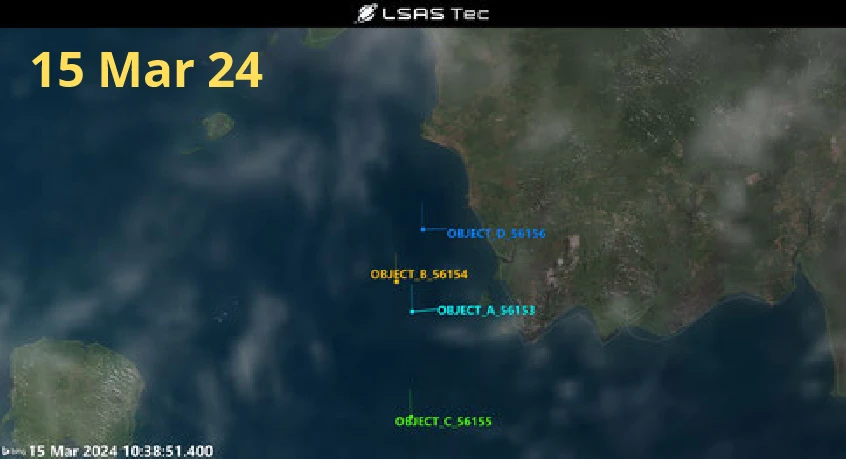
The satellite order seems to actually change within the day depending on the hour as well.
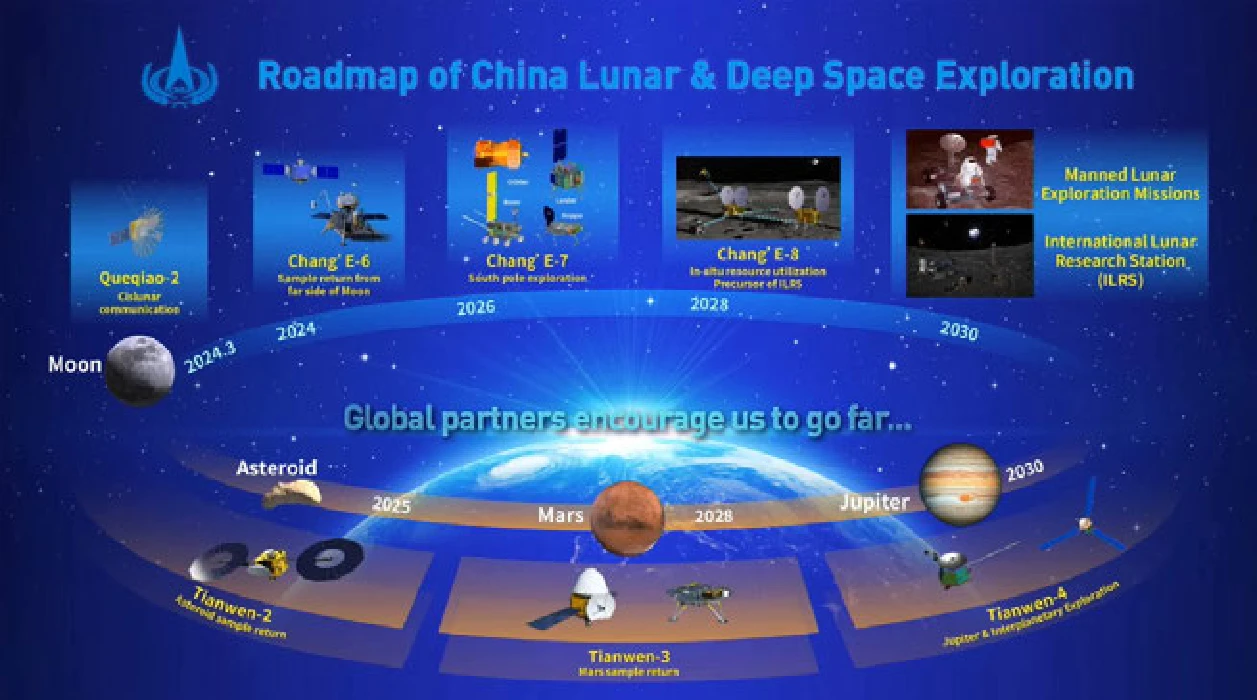
China launched the Queqiao-2 lunar relay satellite to support Chang’e missions, including far-side and south-pole exploration.
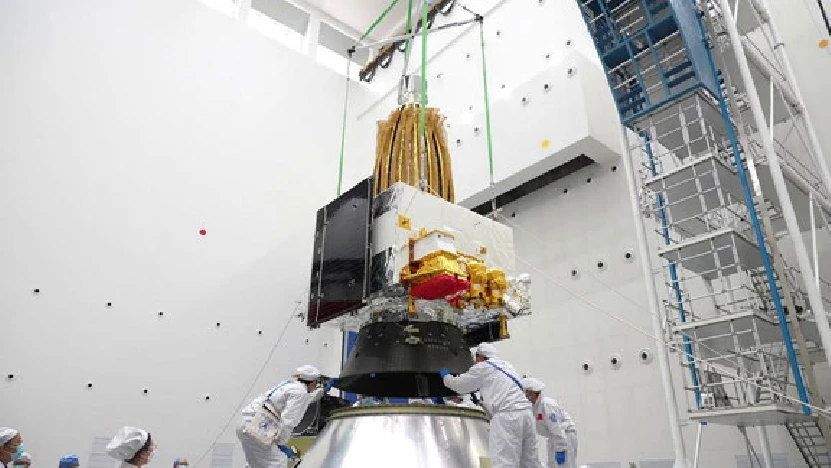
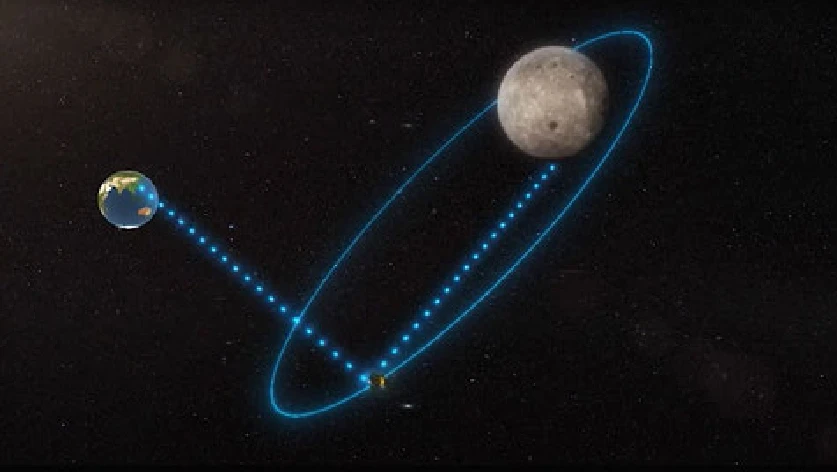
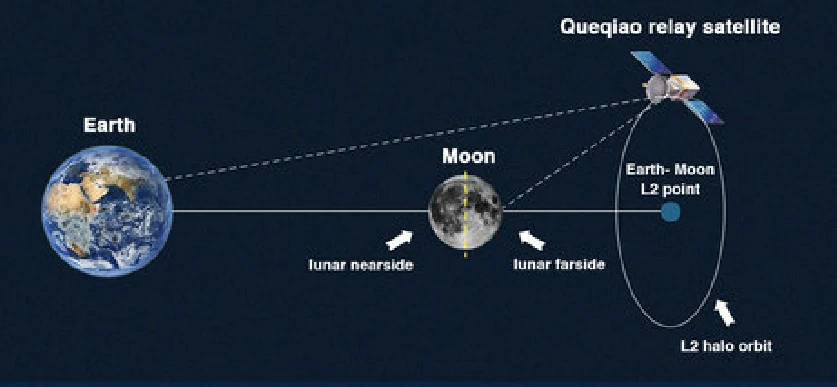
20 Mar 2024: China launched a LM-8 from Wenchang carrying Queqiao-2 (Magpie Bridge-2) lunar relay satellite. According to the China National Space Administration the satellite separated from the rocket, and entered the planned Earth-Moon transfer orbit with the perigee at 200km and apogee of 420,000km. China will position the Queqiao-2 in a highly elliptical lunar orbit to provide provide communications services for the Chang’e-4, Chang’e-6, Chang’e-7 and Chang’e-8 lunar missions including those operating on the far side of the moon. Launch Video.

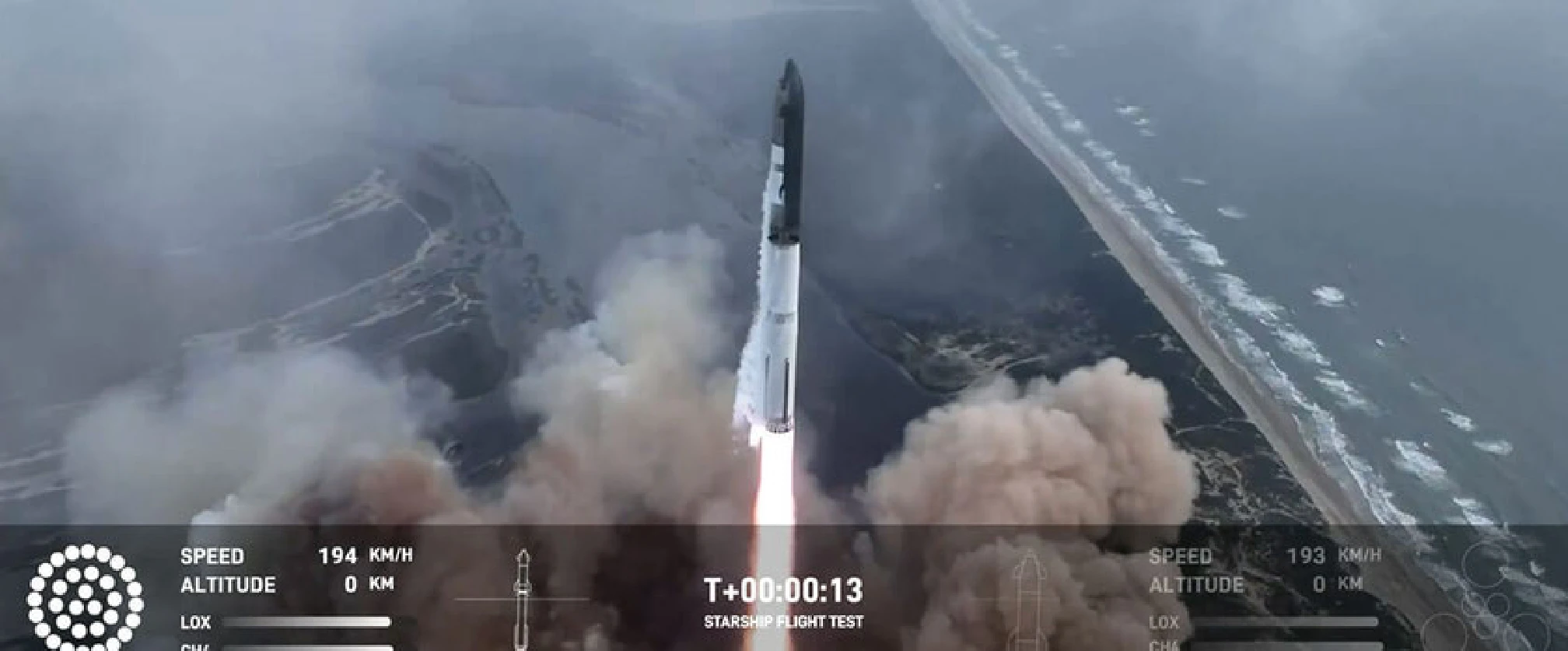
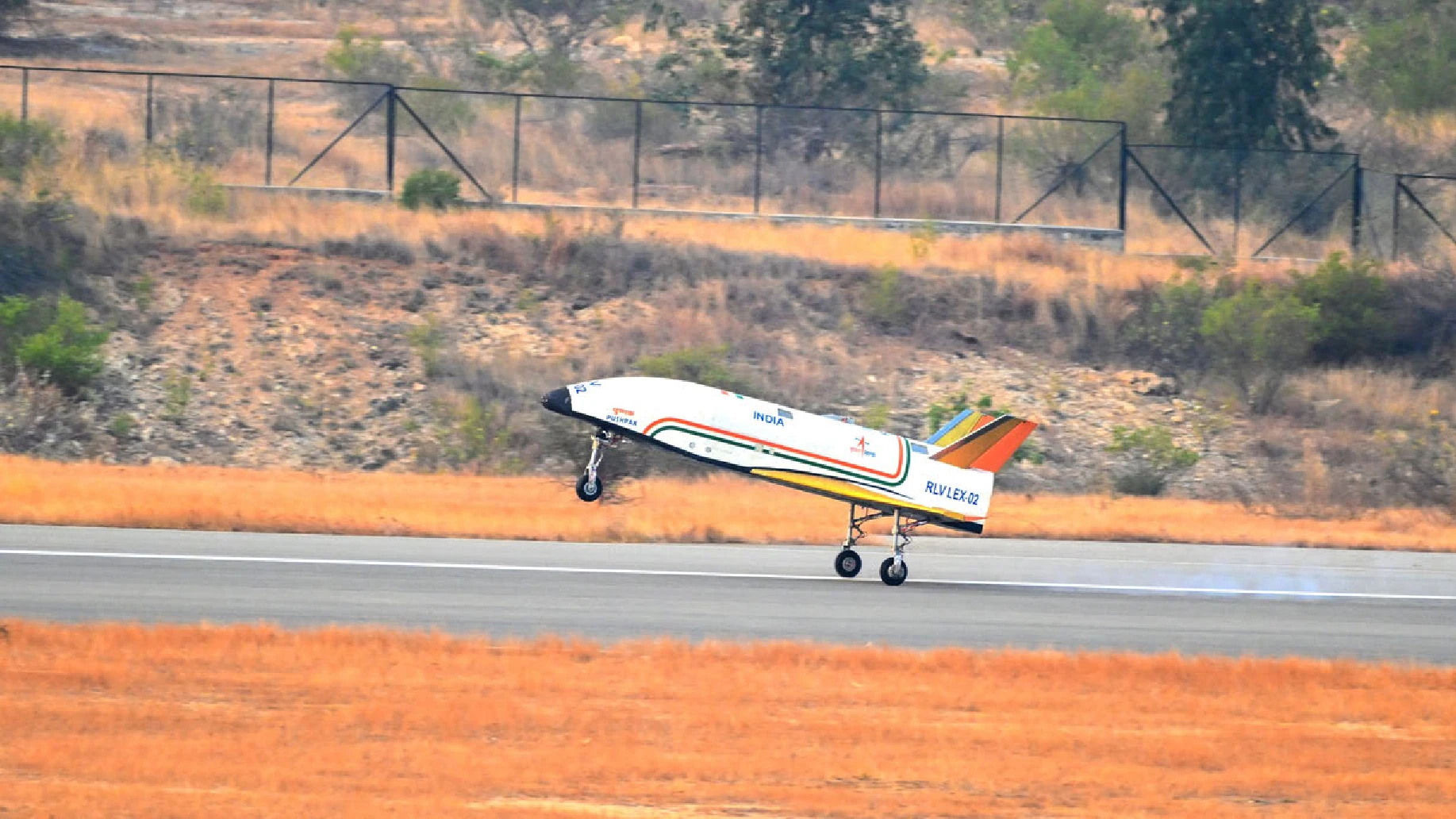
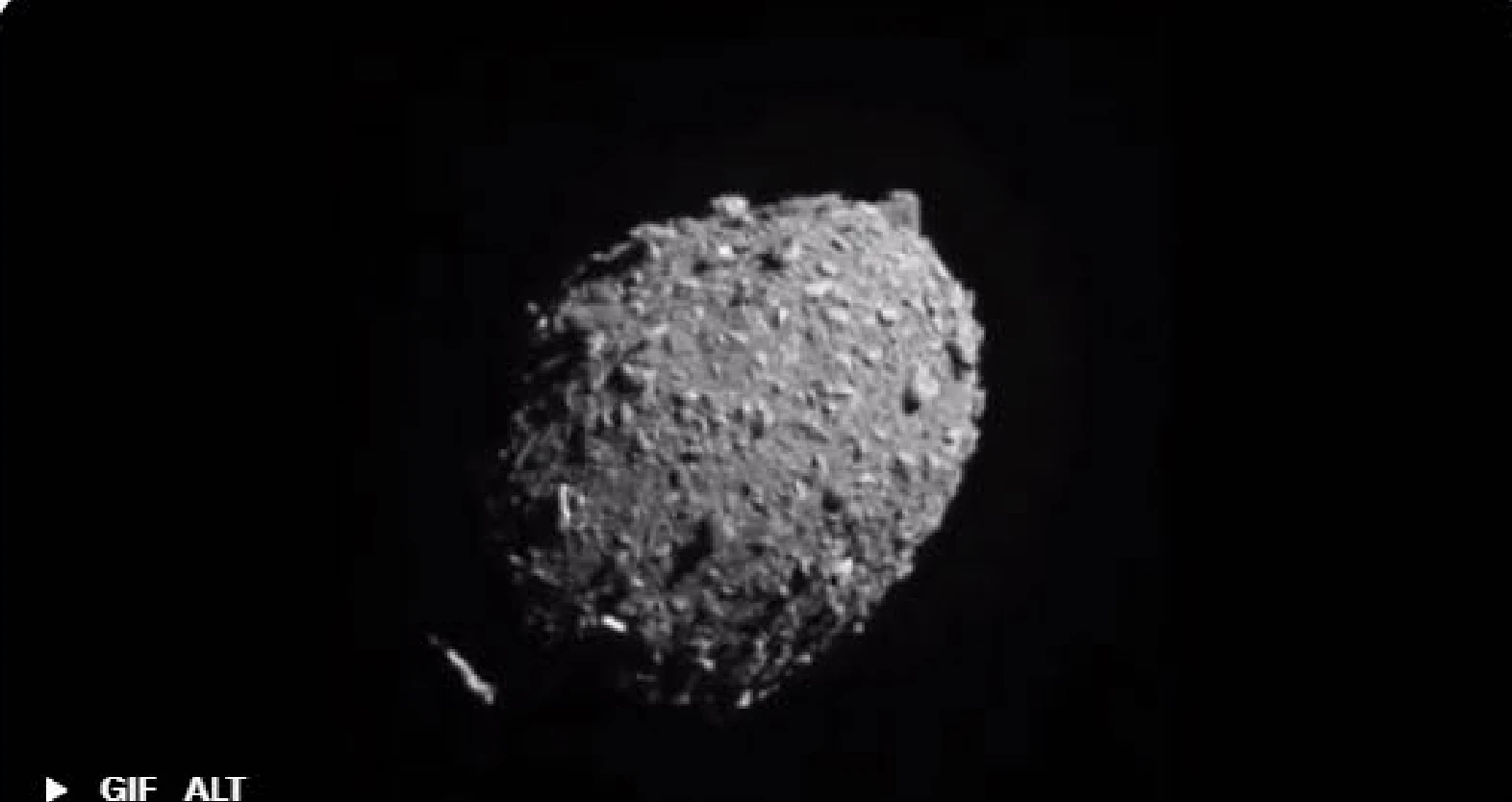
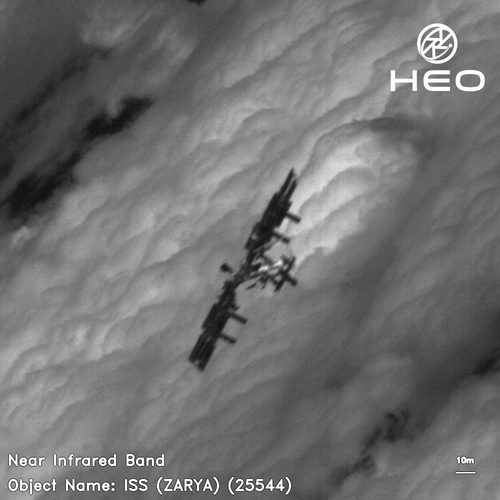
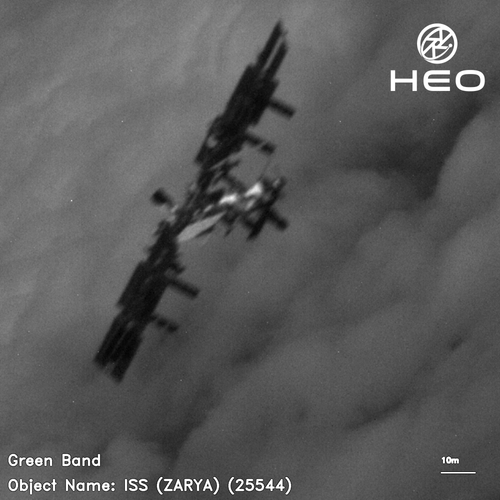
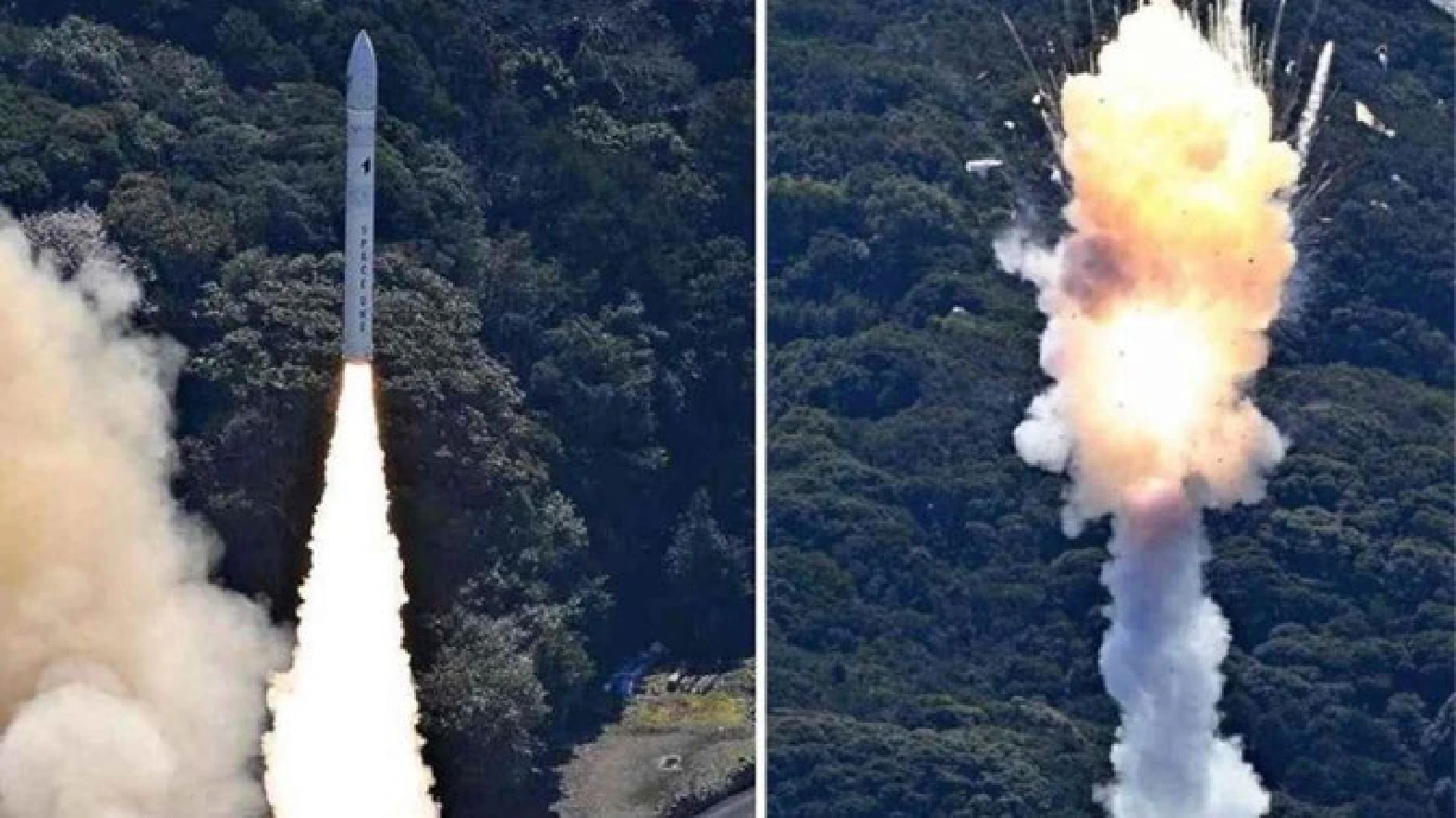
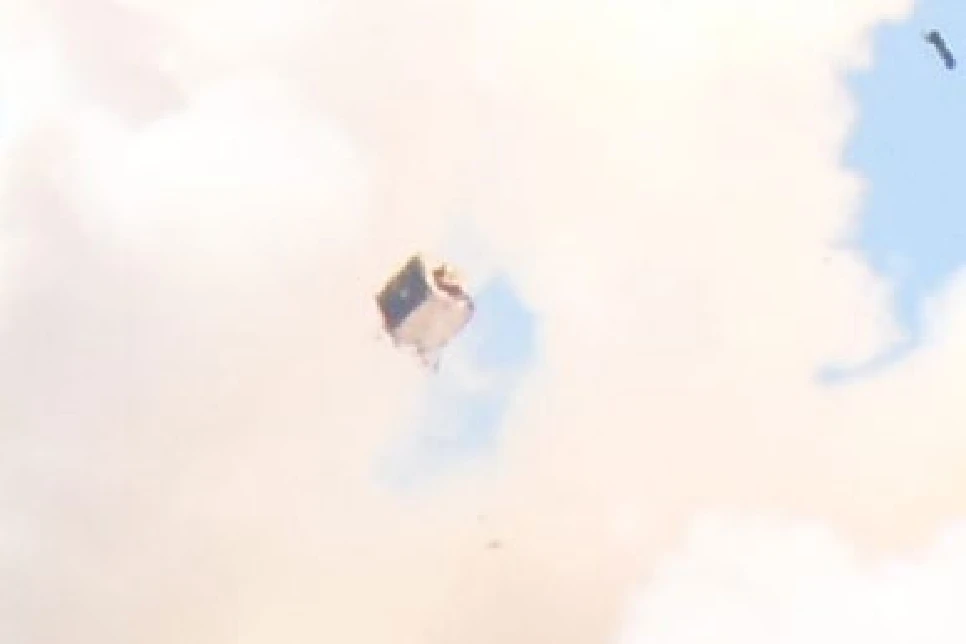
Space imagery and photographs featured in Issue 93.


Flash Insider
Subscribe to unlock full access to this Issue and the complete Flash archive.
Subscribe Now Already Subscribed? Log In « BackInsider feature
Download any issue or article as a brief-ready PDF or clean HTML. Become a Flash Insider to unlock exports and the full archive.
See Insider plans Already an Insider? Log in