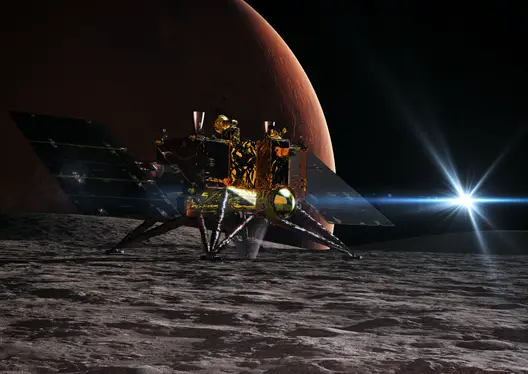
Up, over, back down, in close, and out again: a consolidated look at the Cosmos 2612 / ICEYE-X36 episode, April through 23 October 2026, and what to watch for next with ICEYE-X37.
Plane changes in low Earth orbit are rare, because they are expensive. That single fact is the key to reading Cosmos 2612 story, and it is why the decisive signal in this episode appeared months before the close approach that drew headlines.
In October, Russia maneuvered Cosmos 2612 (68762) into the orbital plane of ICEYE-X36 (59103), a commercial Synthetic Aperture Radar (SAR) satellite that supports Ukraine, closed to within a few hundred meters on 17–18 October, backed away, and on 20 October parked itself in X36’s orbit roughly 400 kilometers behind it (watch COMSPOC Video). Meanwhile, two of its siblings, Cosmos 2613 and 2611, are drifting toward the orbital plane of a second ICEYE satellite, X37, with crossings around 5 and 14 November. 2612’s maneuvering was deliberate, efficient, and observable. What Russia intends to do from that position is not observable at all. Holding those two statements apart is the entire discipline of this kind of analysis, so this piece is organized around it: what the data shows, what we can reasonably assess, what remains merely possible, and what the evidence does not support.
COSMOS 2612 (SSC.68762) walks up to ICEYE-X36 (SSC.59103)
— COMSPOC_OPS (@COMSPOC_OPS) October 24, 2026
In July we posted on the Cosmos 2609–2614 group. Back then we flagged COSMOS 2612 as the satellite best placed to reach ICEYE-X36. Three months later, it did.
Analysis via COMSPOC SSA.
On 1 October COSMOS 2612 raised… pic.twitter.com/CPxrabv4LR
COSMOS 2612 (SSC.68762) walks up to ICEYE-X36 (SSC.59103) (COMSPOC_OPS via X)
What we observed in May
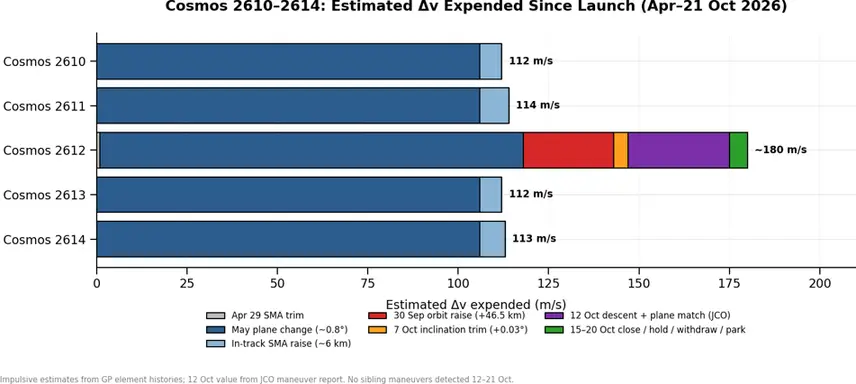
Russia launched Cosmos 2609 through 2614 on 17 April 2026, using a Soyuz 2.1b with a Volga upper stage. Between roughly 13 and 21 May, Russia raised the inclination of five of those satellites, Cosmos 2610 through 2614, by about 0.8 degrees, bringing them to 97.8 degrees and nearly co-planar with ICEYE-X36.
The significant word is co-planar. Each of those inclination changes cost on the order of 106 meters per second of delta-v. That figure is spacecraft agnostic, and it is large for small LEO satellites. A satellite built only for routine earth observation, signal collection, or communications does not typically carry the propulsion budget to make that kind of move, let alone make it five times across a cluster. The expenditure itself was evidence that these satellites were built to maneuver aggressively.
Over the same window the cross-track range between Cosmos 2612 and ICEYE-X36 fell from roughly 100 kilometers to under 5 kilometers. By 29 May, Cosmos 2614 was the closest of the group, passing ICEYE-X36 four times inside 20 kilometers over a two and a half hour span, with the lighting geometry favoring the Russian satellite on two of those passes.
Our read at the time, documented in Issue 146 of The Integrity Flash and in our companion analysis, was stated carefully: we did not know Russia’s intentions or the specific capabilities of those satellites, but maneuvering into a co-planar orbit is alarming, because plane matching is the first and most fuel-expensive step toward Rendezvous and Proximity Operations (RPO). In Issue 152 (23 August) we noted the five were stacked 0.6–5.2 km above X36, slowly phasing through the plane, and none had maneuvered to stay plane-matched. Cosmos 2612 was the closest, just 0.6 km above X36.
The setup: up, over and back down
Sitting slightly above X36 through the summer, Cosmos 2612’s plane precessed a little slower than X36’s. By 30 September its RAAN had drifted about 0.24° from X36’s, roughly 28 km of maximum cross-track separation. Fixing that directly would have taken a ~31 m/sec cross-track burn. Russia chose a different route, and in hindsight the next two weeks were one deliberate sequence:
- 30 Sep climb (~25 m/sec): Raising 2612 ~46.5 km to ~590 km slowed its precession enough that J2 walked its plane back toward X36’s at ~0.02°/day. The higher orbit also increased 2612's orbital period and, as a result, X36 would pass 2612 about once every 7 days.
- 7 Oct trim (~4 m/sec): A small inclination increase (97.870° → 97.901°) fine-tuned the precession rate, most likely timing the plane crossing to the planned descent window.
- 12 Oct descent (27.9 m/sec, 0217Z): With the planes aligned, 2612 dropped its period 59.5 seconds and trimmed its inclination ~0.05° to 97.85°. In a single maneuver it nearly matched X36’s altitude (555 vs 556 km), inclination, and orbital plane, trailing by ~475 km. Because both now sat at nearly the same altitude, their RAAN values changed at the same daily rate and the planes stay matched without further maneuvering.
Commercial space domain awareness providers supporting the Joint Commercial Operations (JCO) Cell flagged the 12 October burn as a possible RPO initiation, and we reported it the same day in Issue 155 of The Integrity Flash. The two-week round trip cost ~57 m/sec. A direct plane fix would have cost about half as much but done nothing for phasing; Russia bought both a corrected plane and a new in-track position. This was a precisely timed and economical setup and demonstrated (at least to me) a clear threat to X36.
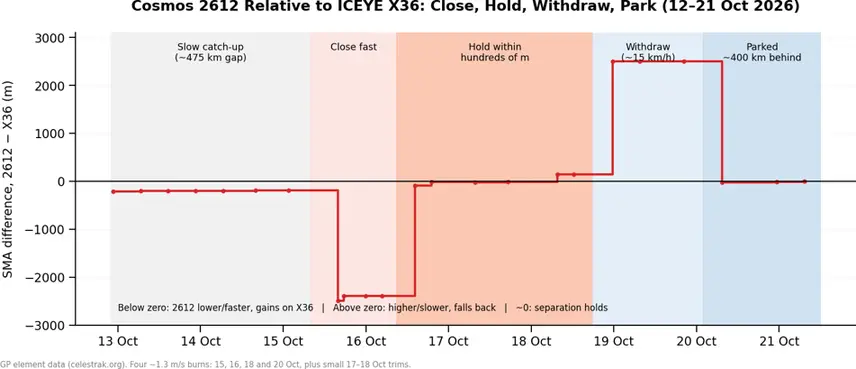
Cosmos 2612 SMA minus ICEYE X36 SMA, 12–21 Oct 2026: close, hold, withdraw, park (based on data from celestrak.org).
Plane matched, shape nearly matched
The first step in setting up an RPO is plane matching (inclination and RAAN). The second is shape matching (eccentricity and argument of perigee). After 12 October both satellites had eccentricities of about 0.002, with arguments of perigee about 4° apart, a difference worth an estimated 0.25 m/sec. The expensive part was done. Closing an in-track gap with plane and shape already matched takes only small changes in altitude (SMA), and the closure rate is Russia’s to choose. X36, a ~90 kg smallsat whose last detectable maneuver was a ~0.6 km SMA reduction on 25–27 June, had unknown propellant and limited ability to evade.
Russia waited 3 days to close the gap.
- 15 Oct, close: 2612 dropped its SMA about 2.3 km below X36’s. A lower orbit is a faster orbit, so it began eating into the ~475 km in-track gap quickly.
- 16 Oct, stop: It raised its SMA by about the same amount, back to X36’s altitude, arresting the closure in the satellite’s vicinity.
- 17–18 Oct, hold: Small trims of roughly 0.1–0.15 km, consistent with the repeated station-keeping LeoLabs described while 2612 sat within hundreds of meters. Most of these maneuvers are so small that they do not show up in orbital tracking data.
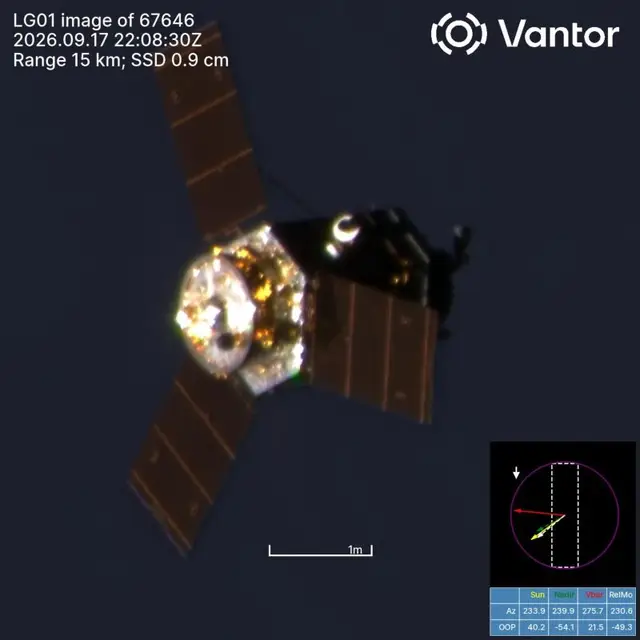
On 17 October Vantor was able to capture an image of both satellites separated by just over 1km.
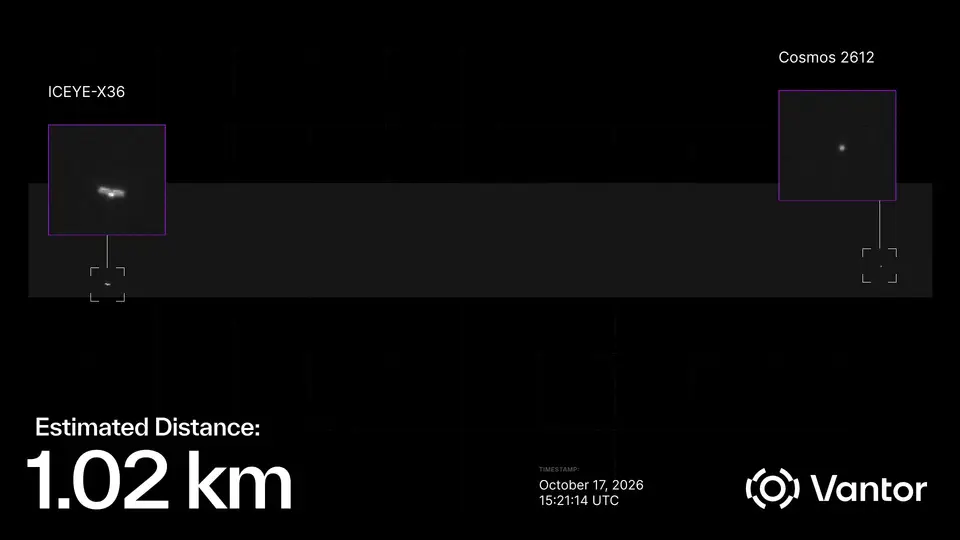
Cosmos 2612 in trail position about 1km from ICEYE X36 (axios.com & @TomNovelly via X)
According to LeoLabs vice president of technical solutions Adam Marsh, between 17-18 October Cosmos 2612 had closed to within a couple hundred meters of ICEYE-X36 and was maneuvering repeatedly to hold that position. ICEYE-X36 did not maneuver to open the distance. COMSPOC_OPS presented similar analysis, “From 16–18 October they (2612 & X36) spent ~24 hours within 2 km of each other and ~12 hours within 1 km…Closest pass in our solution was ~60 m (max uncertainty ~950 m) near 14:18 UTC (17 Oct).”
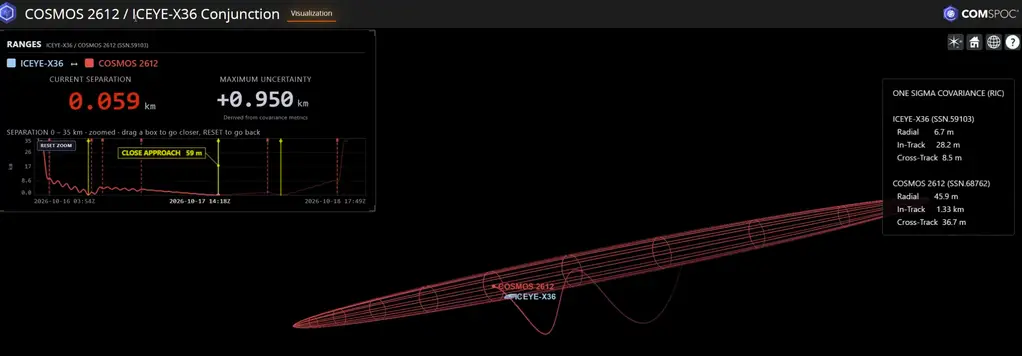
COMSPOC Visualization of ~60m Close Approach (note 950m max uncertainty) (@COMSPOC_OPS via X)
Test Complete?
Then Cosmos 2612 backed off. Late on Sunday, 18 October, it raised into a slightly higher orbit, which slowed it relative to ICEYE-X36. By Monday afternoon the separation was reported at ~400 km and growing by roughly 16 km per hour.
- Late 18 Oct, withdraw: A ~2.3 km raise put 2612 above X36. A higher orbit is a slower orbit, and the gap opened at roughly 15 km per hour.
- 20 Oct, park: Between 2018Z on 19 October and 0727Z on 20 October, 2612 lowered its SMA ~2.5 km, back to within about 20 meters of X36’s. That stopped the drift. It now trails X36 by roughly 480 km and, with the two at essentially the same altitude, that gap is holding nearly constant.
The two satellites remain plane-matched. Through 21 October the RAAN difference is <0.004° and inclinations agree to within 0.001°. X36 has still not maneuvered, and none of 2612’s four siblings have maneuvered since 12 October.
For me, the last burn is perhaps the most telling. Russia did not withdraw Cosmos 2612 to a parking orbit of its own or rejoin its siblings. It backed out a few hundred kilometers and then deliberately re-matched X36’s orbit. From where it sits, a ~2 km drop in SMA would bring it back alongside X36 in roughly a day.
Why so close?
Planning an RPO while remaining passively safe a few hundred meters from an uncooperative target (with unknown maneuver capability) requires continuous, deliberate control, which is exactly what the repeated maneuvers Marsh described indicate. This was not a drift-by. It was a position, actively maintained.
Estimates of the closest point vary with the limits of tracking. LeoLabs told Ars Technica that Cosmos 2612 came within 500 meters and likely much closer, and a US official at the UN suggested it may have closed to roughly 100 feet (~30 m). As noted previously, COMPSOC noted a possible 60m close approach…in any case the conclusion is the same: Russia deliberately maneuvered to within 1km of ICEYE X36.
Bringing Cosmos 2612 within 1km of a satellite noted for supporting Russia's adversary is most likely to support a kinetic attack. Imaging the satellite or collecting/disrupting its signals can be done from much greater distances and more effectively. Russia did everything necessary to engage X36 save pull the trigger. Engage with what is a fair question…we don’t know the 2612's payload. Nets, harpoons, sub-satellites/projectiles are all possibilities. The advantage of having a co-orbital weapon is the much lower relative velocity which enables the attacker to destroy its target without generating a massive debris field. We covered this with Jack Anthony years ago. COMSPOC estimated a differential velocity of “0.15–0.9 m/s, walking pace or slower.” Compare this with a direct ascent anti-satellite (DA-ASAT) missile which strikes its target in speeds measured in km/sec. I’ll guess at Russia’s intent later, but I’m confident they did not conduct this RPO to collect intelligence on a commercial radar imaging satellite.
Fuel accounting
Through the 20 October parking burn, Cosmos 2612 has expended roughly 180 m/sec since launch, about 65 m/sec more than any of its four siblings. Russia spent ~57 m/sec in two weeks on the setup, then only ~5 m/sec on the entire close, hold, withdraw and park sequence of 15–20 October. The other four, at ~112–114 m/sec each, have not maneuvered since July.
Next in line: ICEYE-X37
Cosmos 2612 is not the only satellite from the April launch with a commercial radar satellite in its sights. Since the May plane changes, the slow, uneven J2 drift we tracked against X36 has been carrying the other four siblings toward and through the planes of another nearby ICEYE spacecraft. Two of them are now approaching ICEYE-X37 (59102): Cosmos 2613 (68763) first, around 5 November, then Cosmos 2611 (68759), around 14 November. Neither has maneuvered since July, and the projected crossing dates hold to within a day across every data window from September through 21 October.
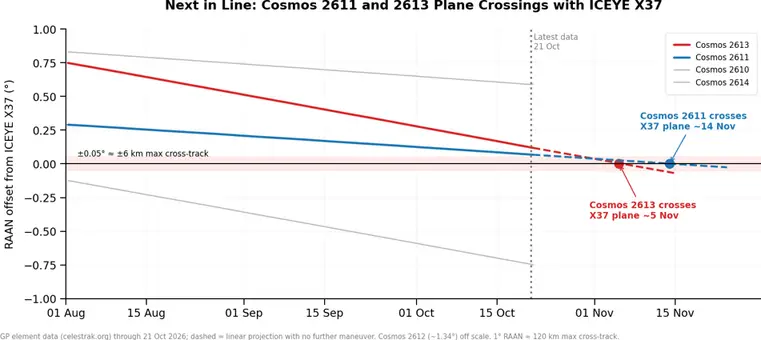
RAAN offset of Cosmos 2610, 2611, 2613 and 2614 from ICEYE-X37, Aug–21 Oct 2026, with no-maneuver projections (GP element data, celestrak.org).
What we would see if Russia goes after X37
Cosmos 2612 gave us a template, and each step of it is observable. If Russia intends a second close approach on an ICEYE satellite, the first indication will be a plane match maneuver.
- A burn that freezes the plane, near the crossing: The decisive signal. For 2613, a small descent toward X37’s altitude (~2.9 km) combined with an inclination trim (~0.05°) within a few days of 5 November. For 2611, a ~0.8 km drop and ~0.02° trim any time from late October through November. Once a sibling sits at X37’s altitude and inclination, J2 precesses both planes at the same rate and the alignment holds without further cross-track burns. This is the equivalent of 2612’s 12 October burn, and JCO providers would likely flag it as a possible RPO initiation.
- Alternatively, a J2 timing move: If Russia needs more time or a different crossing date, it may repeat 2612’s 30 September approach: raise or lower the orbit to change the precession rate and walk the plane into place, possibly with a small inclination trim like 2612’s 7 October burn.
Editor’s Comments
Like the Uncle who offers to help clean the dishes as you’re drying the last piece of silverware, US official responses arrived on 21 October at the UN General Assembly’s First Committee. As reported by Ars Technica, State Department official Brian Hardesty told the committee that Cosmos 2612 had shown threatening behavior and that its actions “appear consistent with an on-orbit weapons operation,” calling the decision deliberately reckless and a violation of long-established safety thresholds in LEO. Under Secretary of State Thomas DiNanno echoed the message on X. Jessup Taylor, the US Deputy Permanent Representative to the Conference on Disarmament, suggested Cosmos 2612 may ultimately have closed to roughly 100 feet, noted that Russia never explained why a military satellite moved within tens of meters of another country’s commercial satellite, and summed it up neatly: what you do in orbit speaks louder than what you say on the ground. These were the first US government statements since the approach.
Russia’s Konstantin Vorontsov, (yes, the same diplomat who in 2022 called commercial satellites supporting Ukraine potential “legitimate” targets for retaliation) offered vapid reassurances. Voronstsov described US & European concerns as unfounded “loudspeaker diplomacy” and insisted that all Russian space activity, specifically including Cosmos 2612, is “purely peaceful in character.” Color me skeptical.
I had the opportunity to talk through this event with Kari Bingen and Clayton Swope on the CSIS channel, and I’d encourage readers to watch the full interview. We spent a good part of the conversation on the question I can’t yet answer: what is Russia actually trying to accomplish?
The military logic of going after X36 itself is thin. In the past two months alone ICEYE has launched eight additional SAR satellites, bringing its constellation to more than 60 operational spacecraft. Destroying or disabling one of them would not be insignificant, and it would certainly be a dangerous precedent, but it would not appreciably affect the imagery Ukraine receives. If Russia was attempting to deter either Ukraine or ICEYE, this seems to have failed.
One reader (thank you Thomas), writing after the CSIS discussion, offered the explanation that makes the most sense to me: that this RPO is about testing whether NATO’s Article 5 would hold, and dividing the alliance in the process. That fits a pattern we see in other domains. Thomas noted, “At the 2021 Brussels Summit, NATO stated that attacks to, from, or within space could lead to the invocation of Article 5, to be decided case by case. That deliberate ambiguity is exactly what makes it testable.” Russia used a military satellite to threaten an asset owned by NATO members and probe the line of what would trigger Article 5. It was a probe of where the line sits, and if the alliance says nothing, the line moves a little.