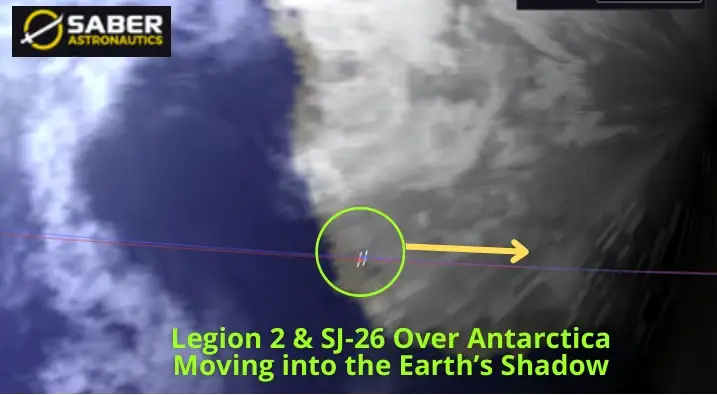
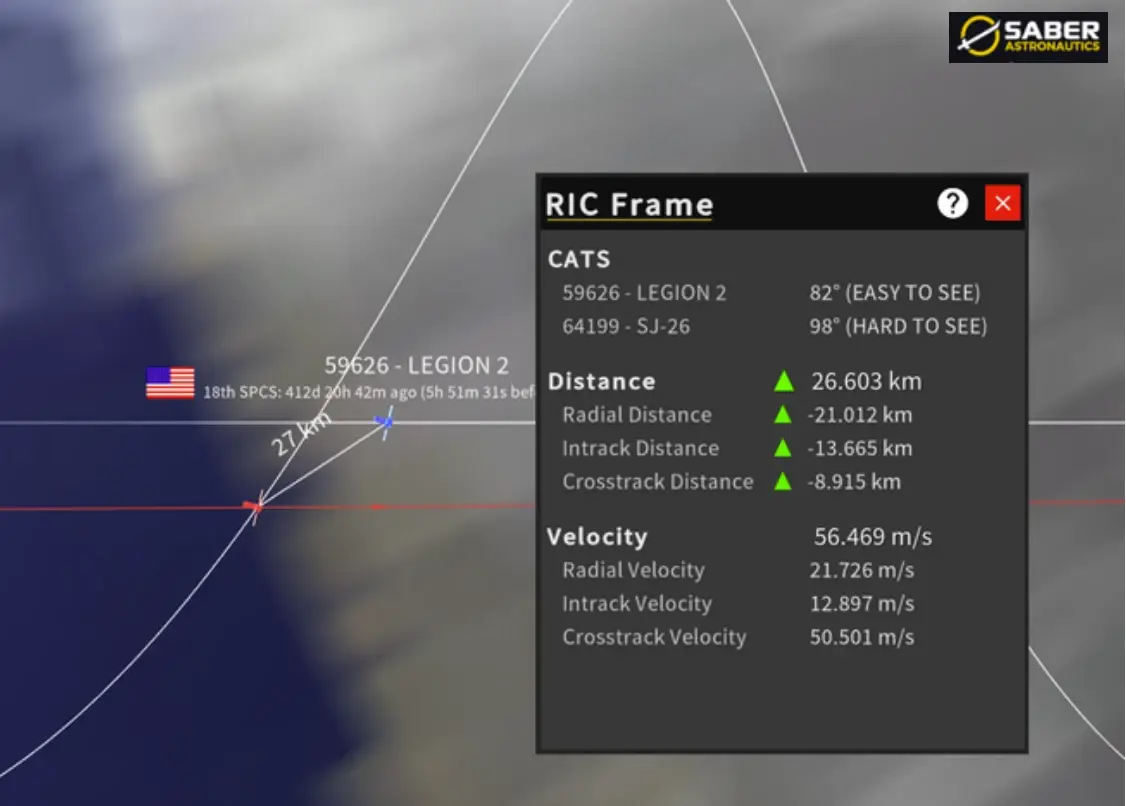
18 Nov 2026: For 18 months Cosmos 2588 (64095), Russia’s Nivelir-class inspector co-orbital with US reconnaissance satellite USA 338 (53883), did one thing with its engine: go up. On 12, 13 and 14 November it went down. Three burns on consecutive days lowered its average altitude ~7.1 km (478.3 → 471.2 km), the lowest it has flown since launch. The third burn put Cosmos 2588 almost exactly at the altitude where its orbital plane turns in step with USA 338’s. Our analysis says the move is aimed at USA 338’s orbital plane, not its altitude: for ~4.4 m/s, Russia stopped a slowly widening plane gap and set it up to close.
Background
As one does with Russian co-orbital counterspace weapons, we have followed Cosmos 2588 since launch:
- Issue 122 (8 Jun 2025): Launched 23 May 2025 on a Soyuz-2.1b/Fregat; Fregat raised the inclination from 67° to 73°, leaving Cosmos 2588 nearly co-planar with USA 338 (RAAN difference 0.11°, inclination difference 0.6°) in a 479 x 463 km orbit. It was the fourth Russian military satellite placed co-orbital with a US optical reconnaissance satellite in five years, after the Cosmos 2558/USA 326 and Cosmos 2576/USA 314 pairings.
- Issue 129 (14 Sep 2025): Russia raised SMA ~6.4 km on 4–9 Sep; the pair had a point of closest approach (POCA) under 100 km roughly every 4 days (84 km on 11 Sep). The maneuvers did not appreciably change POCA distances.
- Issue 138 (9 Feb 2026): Perhaps indicating a new tactic, Cosmos 2588 was holding ~91 km above USA 338, unlike Cosmos 2558 and 2576, which sit below their targets.
A Clear Break From Pattern of Life
Cosmos 2588’s maneuver history is unusually regular. Every campaign before November raised the orbit. Since November 2025 the routine has been nearly identical: let drag lower the orbit to ~476 km, then climb back to ~481.5 km with three burns on consecutive days, roughly every 2.5–4 months.
| Campaign | Avg. altitude (km) | ΔSMA | Est. Δv | Note |
|---|---|---|---|---|
| May 31, 2025 | 472.1 → 473.9 | +1.8 km | 1.0 m/s | First raise after launch |
| 9–10 Jul 25 | 471.7 → 474.8 | +3.2 km | 1.8 m/s | orbit raising |
| 6–9 Sep 25 | 471.6 → 478.0 | +6.4 km | 3.6 m/s | outside PoL (Issue 129) |
| 8–10 Nov 25 | 472.7 → 481.6 | +8.9 km | 4.9 m/s | Sets new ~481 km ceiling |
| 24–26 Jan 26 | 476.0 → 481.5 | +5.5 km | 3.1 m/s | Three daily burns |
| 13–15 Apr 26 | 476.0 → 481.6 | +5.6 km | 3.1 m/s | Three daily burns |
| 20–22 Aug 26 | 476.3 → 481.5 | +5.2 km | 2.9 m/s | Three daily burns |
| 12–14 Nov 26 | 478.3 → 471.2 | −7.1 km | 4.4 m/s | First lowering |
Three things set the November campaign apart. It is the first lowering in the satellite’s life. It came early, at 478.3 km rather than the ~476 km floor where Russia normally reboosts. And it took Cosmos 2588 to the lowest altitude of its mission, ~5 km below its own operating band. What did not change is the operating style. With the third burn, the November campaign is a mirror image of the January, April and August raises: three burns on consecutive days at nearly the same time of day (~1000–1100Z). This is a deliberate change of plan executed with a well-practiced procedure, not routine maintenance.
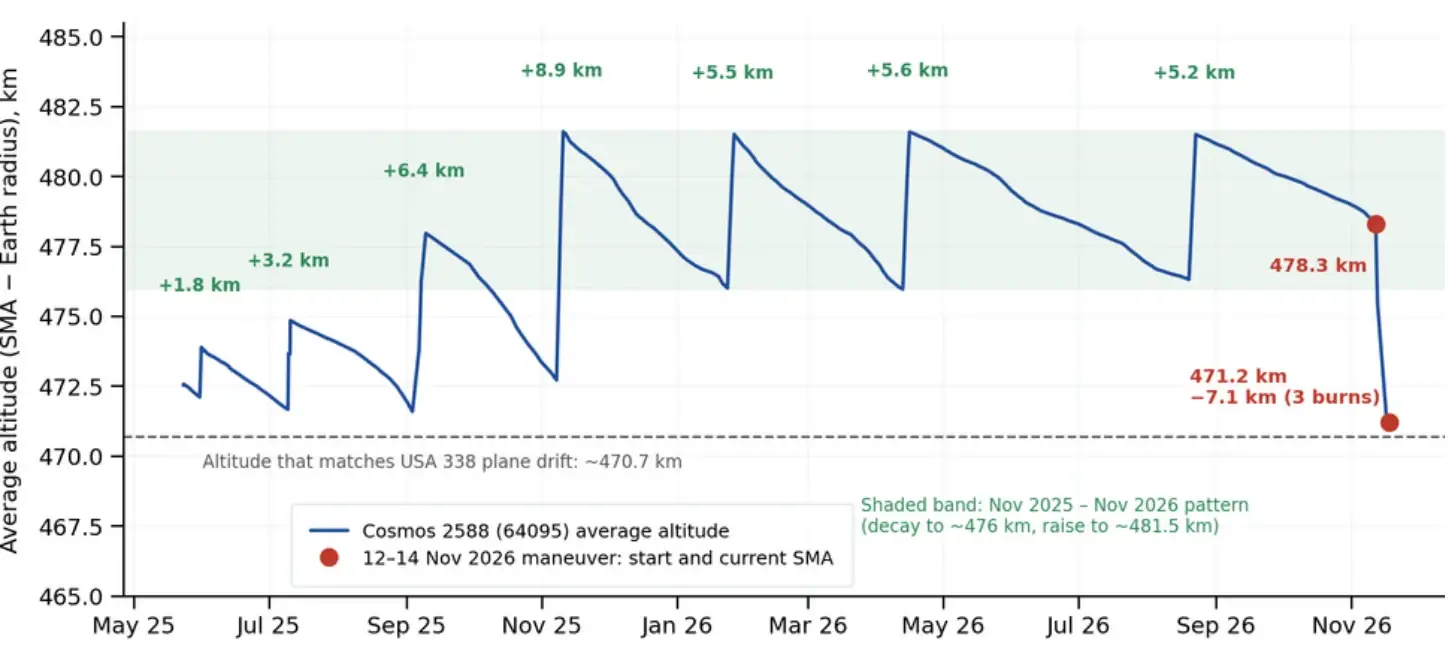
Cosmos 2588 average altitude, May 2025 – Nov 2026. Seven raising campaigns, then the 12–14 Nov lowering. (based on data from Celestrak.org)
What the Maneuver Does to the Co-Planar Relationship
Our only current orbital data for USA 338 is a single TLE (epoch 27 Oct 2026 1759Z) from the McCants catalog. For this analysis we assume USA 338 has not maneuvered since.
| Parameter | USA 338 (27 Oct) | Cosmos 2588 (17 Nov) | Difference |
|---|---|---|---|
| Average altitude | 402.2 km | 471.2 km | 69 km (was 76 km pre-burn) |
| Inclination | 73.58° | 72.97° | 0.61° |
| RAAN (same epoch) | — | — | +0.89° |
| Angle between planes | — | — | ~1.0° |
| Orbital period | 92.61 min | 94.03 min | USA 338 laps 2588 every ~4.3 days |
As with Object C and USA 326, staying co-planar is about matching how fast each orbital plane rotates, not matching altitude or inclination. Both planes swing westward ~2.27° per day under Earth’s oblateness. USA 338’s lower altitude speeds its rotation; its slightly higher inclination slows it. For Cosmos 2588’s inclination, the altitude that keeps its plane turning in step with USA 338’s is ~470.7 km (J2 model, ±1.5 km). Above that altitude the RAAN gap grows; below it, the gap closes.
Holding USA 338 at its 27 Oct elements, the RAAN gap was about −1.0° in June 2026, crossed zero around 3 September, and had grown to +0.87° by 12 November. Each burn slowed the drift: from ~0.009°/day before the campaign, to ~0.006°/day after burn 1, ~0.003°/day after burn 2, and less than 0.001°/day after burn 3. At 471.2 km Cosmos 2588 now sits ~0.5 km above the plane-matching altitude, well inside our model uncertainty. In effect, the third burn froze the plane gap at ~0.89°.
Natural decay (~0.04 km/day) should carry Cosmos 2588 through the plane-matching altitude in about two weeks. If Russia makes no further burns, we project the gap peaks at ~0.89° around 30 Nov 2026 and closes back to zero around Jun 2027. That is roughly six weeks sooner, and ~0.1° lower, than the Issue 158 projection based on two burns. Left on its old pattern, the gap would have passed 1.7° by February and 3° by mid-2027. Doing the same thing directly with a plane-change burn would cost on the order of 100 m/s. Russia is getting there for ~4.4 m/s and some patience.
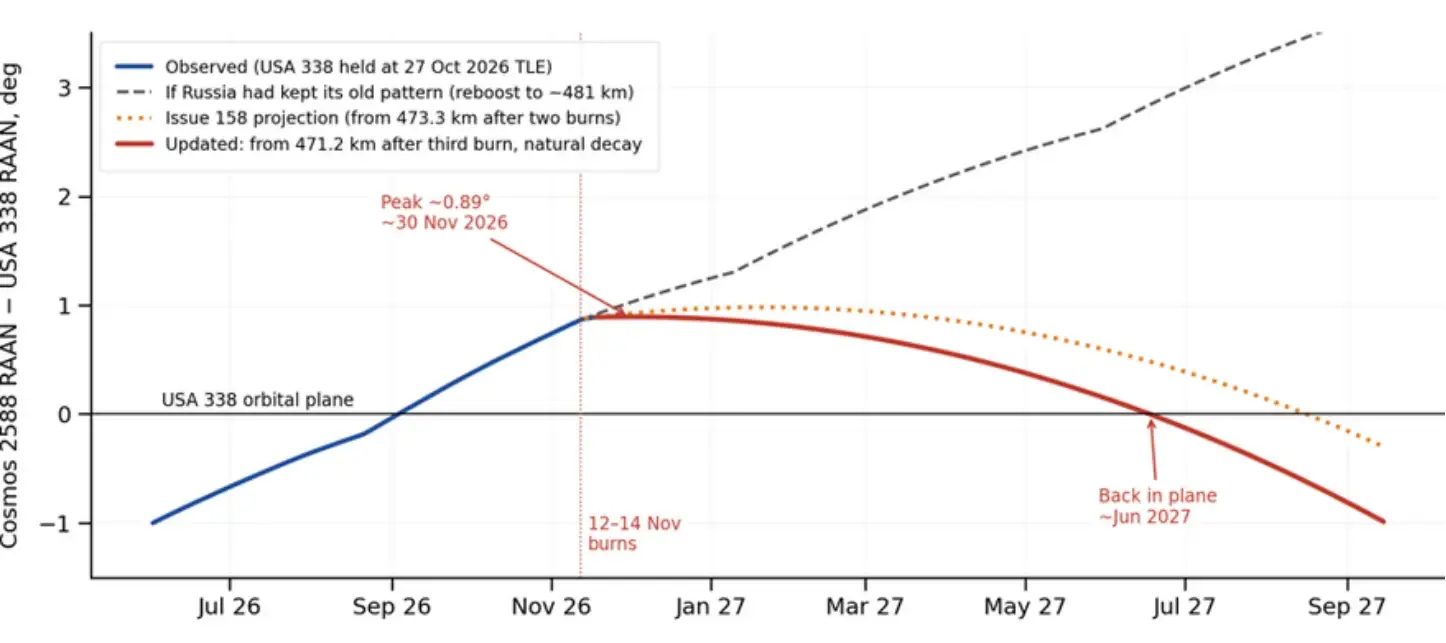
RAAN of Cosmos 2588 relative to USA 338, observed (blue) and projected under three scenarios. The 12–13 Nov maneuver turns a widening gap into one that peaks and closes. (J2 secular model; USA 338 assumed not to maneuver after its 27 Oct 2026 TLE)
Closest approaches: The lowering trims the radial separation from ~76 to ~69 km and stretches the time between passes from ~3.9 to ~4.3 days. Because the planes are ~1° apart, the best-case pass is set mostly by altitude, so the minimum POCA drops only modestly, to just under 70 km. The burns do not create a new close approach by themselves.
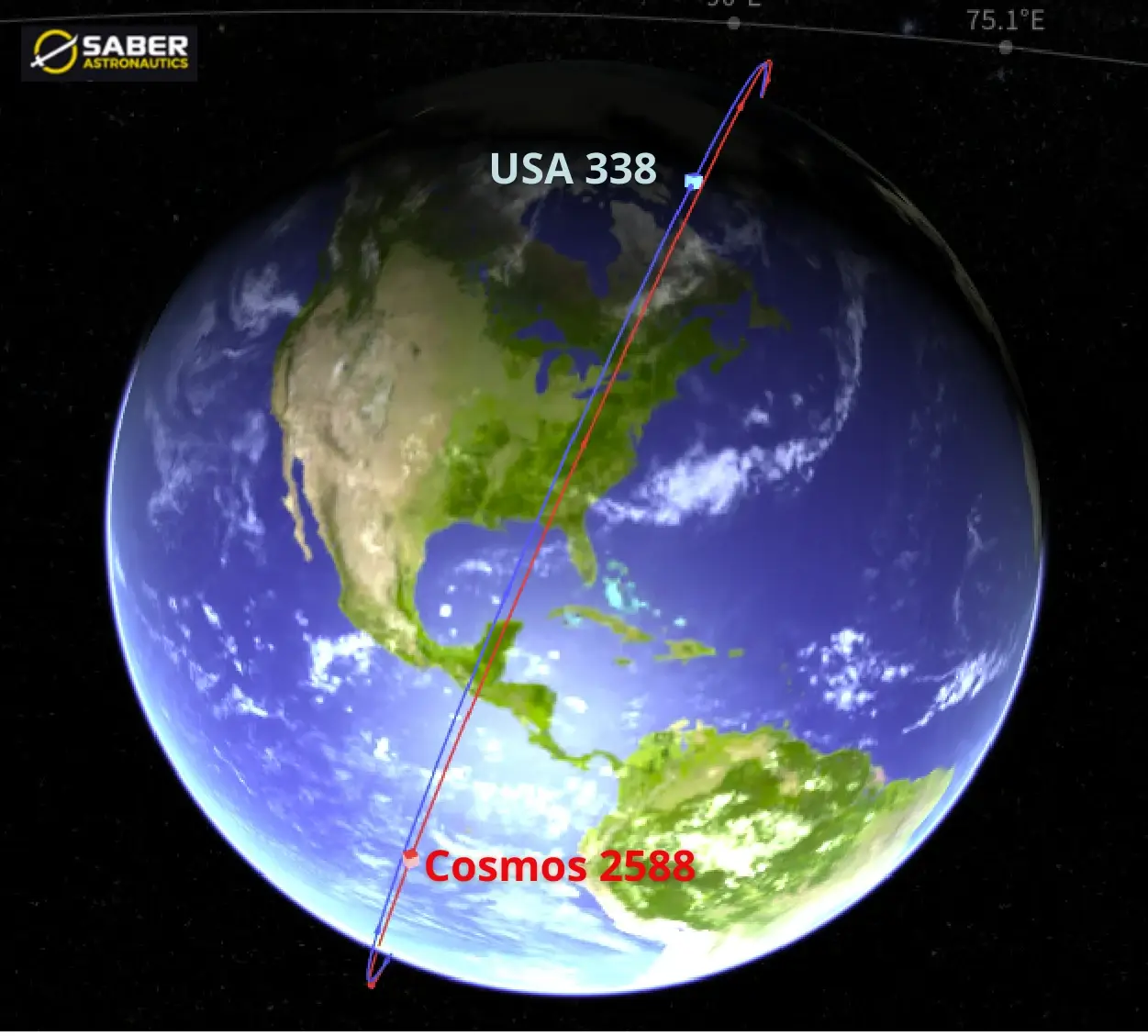
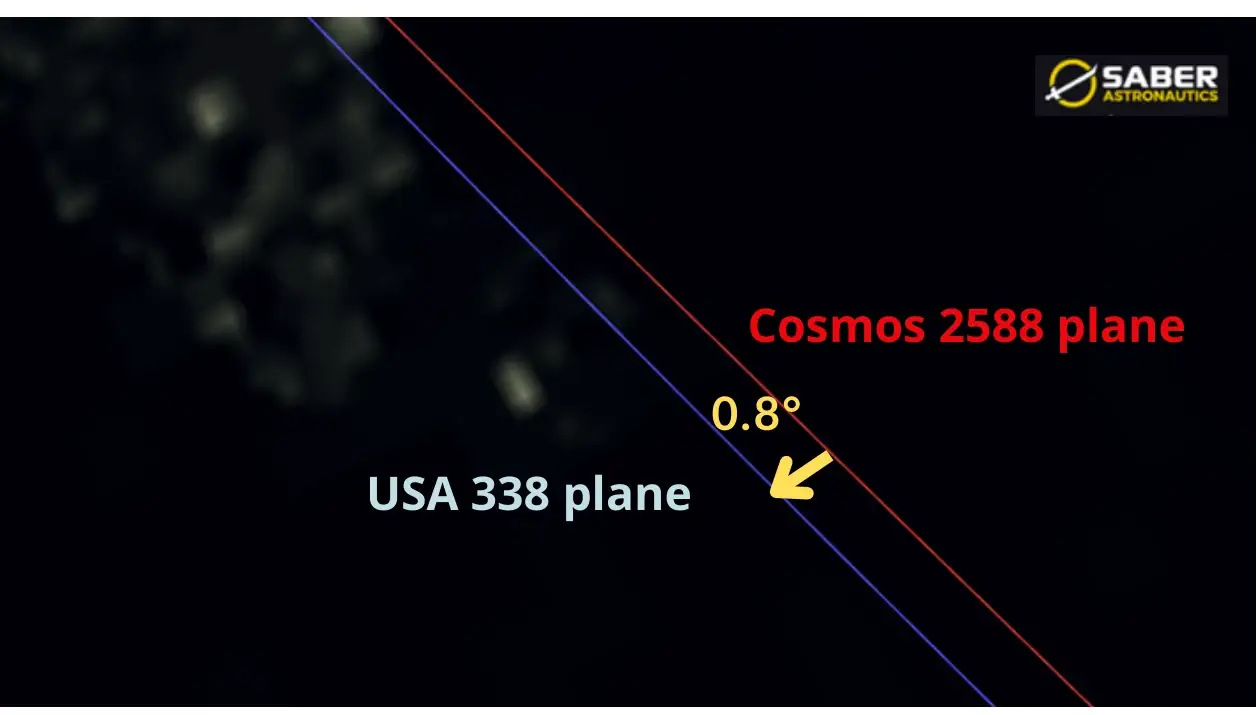
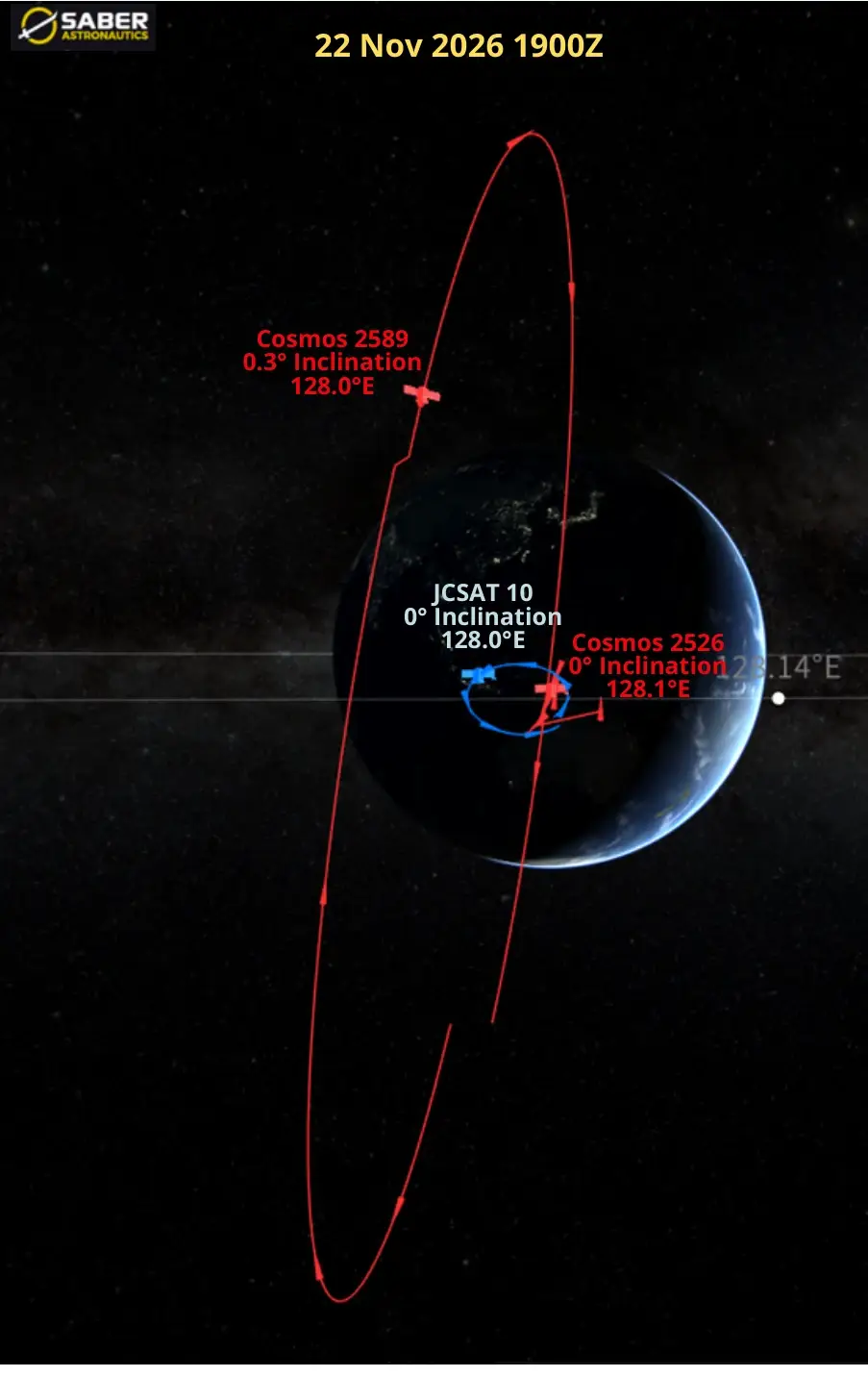
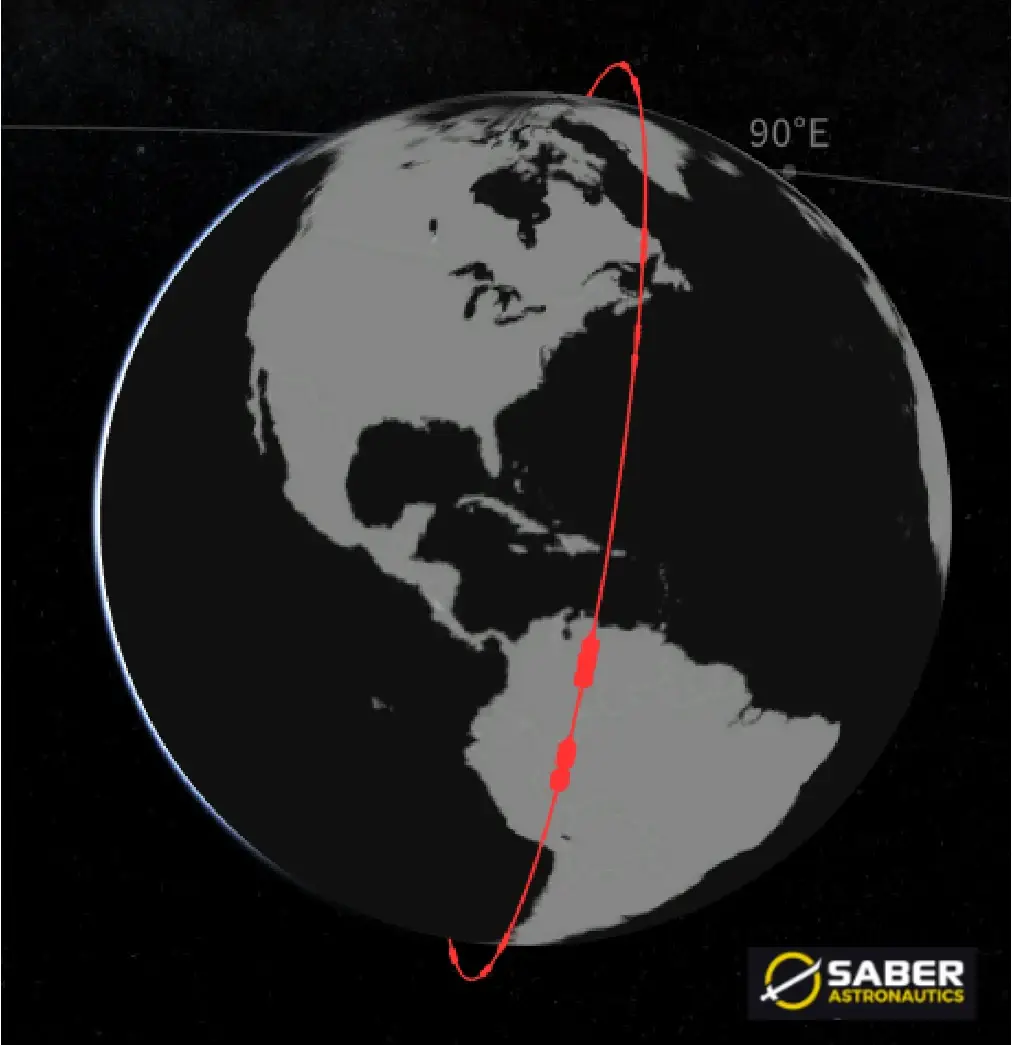
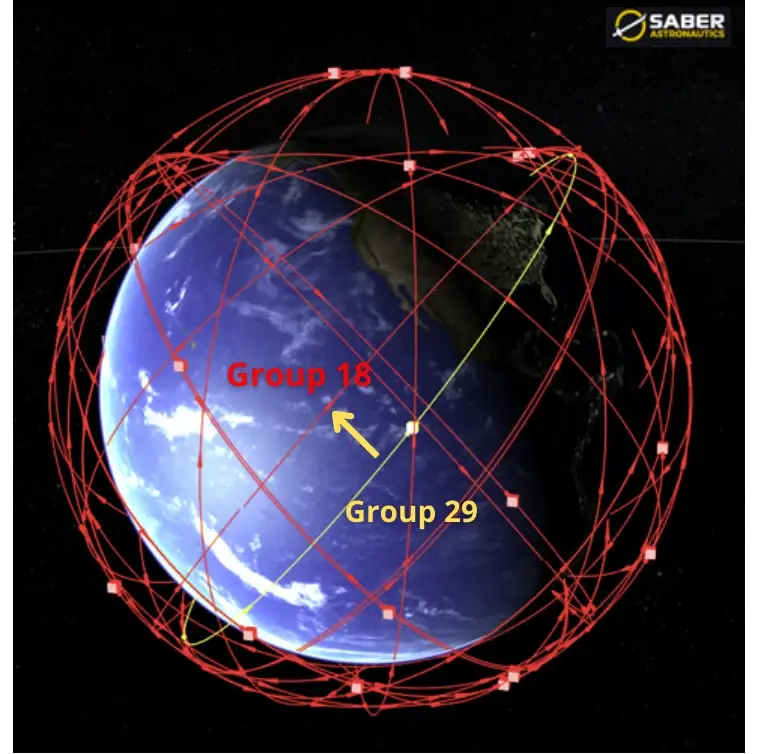
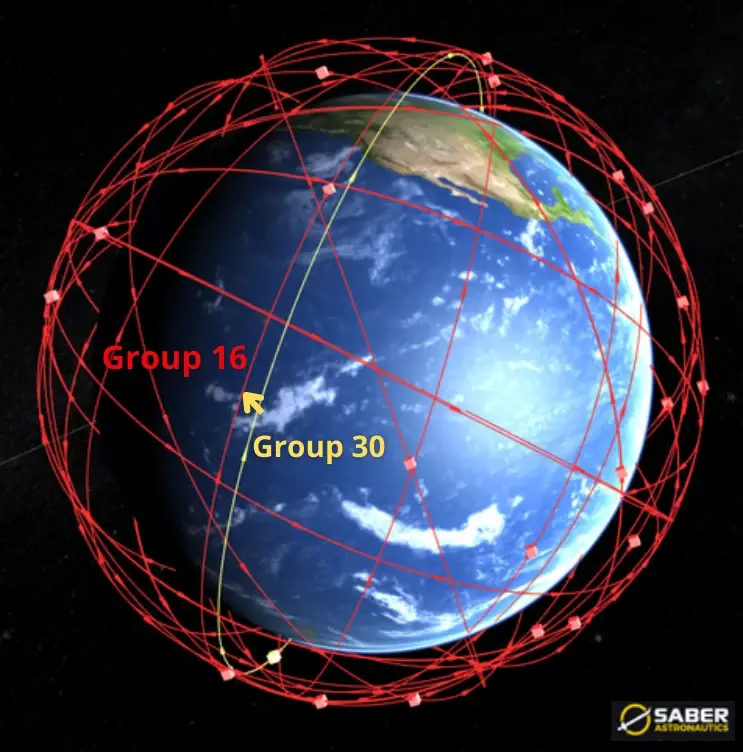
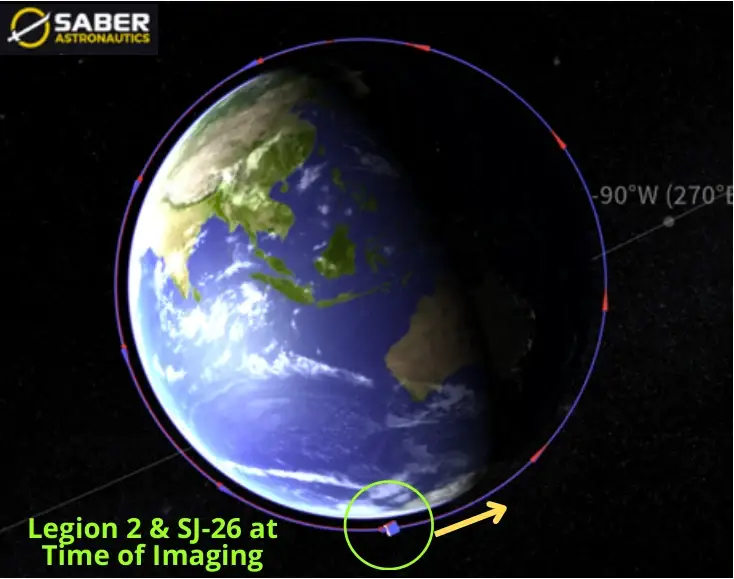
As a result of its recent maneuvers, Cosmos 2588’s orbit plane (red) will gradually move to the west to merge with USA 338’s plane (blue). (saberastro.com)
Longer-Term Assessment: What Is Russia After?
Most likely, plane maintenance by altitude management. The data fit a simple, fuel-efficient control scheme. Russia flew Cosmos 2588 high while the RAAN gap was negative, letting it drift toward USA 338’s plane; the gap crossed zero around September and kept going; now Russia has dropped below its normal band to reverse the drift. Russia did not wait for the usual ~476 km reboost point; it acted once the gap had overshot by roughly as much as it had been on the other side in June.
Editor’s Comment: For a year and a half Cosmos 2588 has behaved predictably: decay, three burns up, repeat. Breaking that rhythm is the most informative thing it has done since Fregat dropped it into USA 338’s orbital plane. The geometry says Russia is not chasing USA 338’s altitude, at least not yet; it is chasing USA 338’s plane, and doing it the cheap way. That is the hallmark of an operator planning to stay in the neighborhood for a long time. As ever, more updates to follow as events warrant.